Trigonal Planar Geometry Molecular Model

SKU: 68823W

$19.95USD or lower Each

Save More When You Buy More!
Quantity1+2+ 3+ 10+ 
Price for each$19.95USD$19.70USD$19.45USD$18.95USD
Your savings - 1.25%2.51%5.01%
Qty:

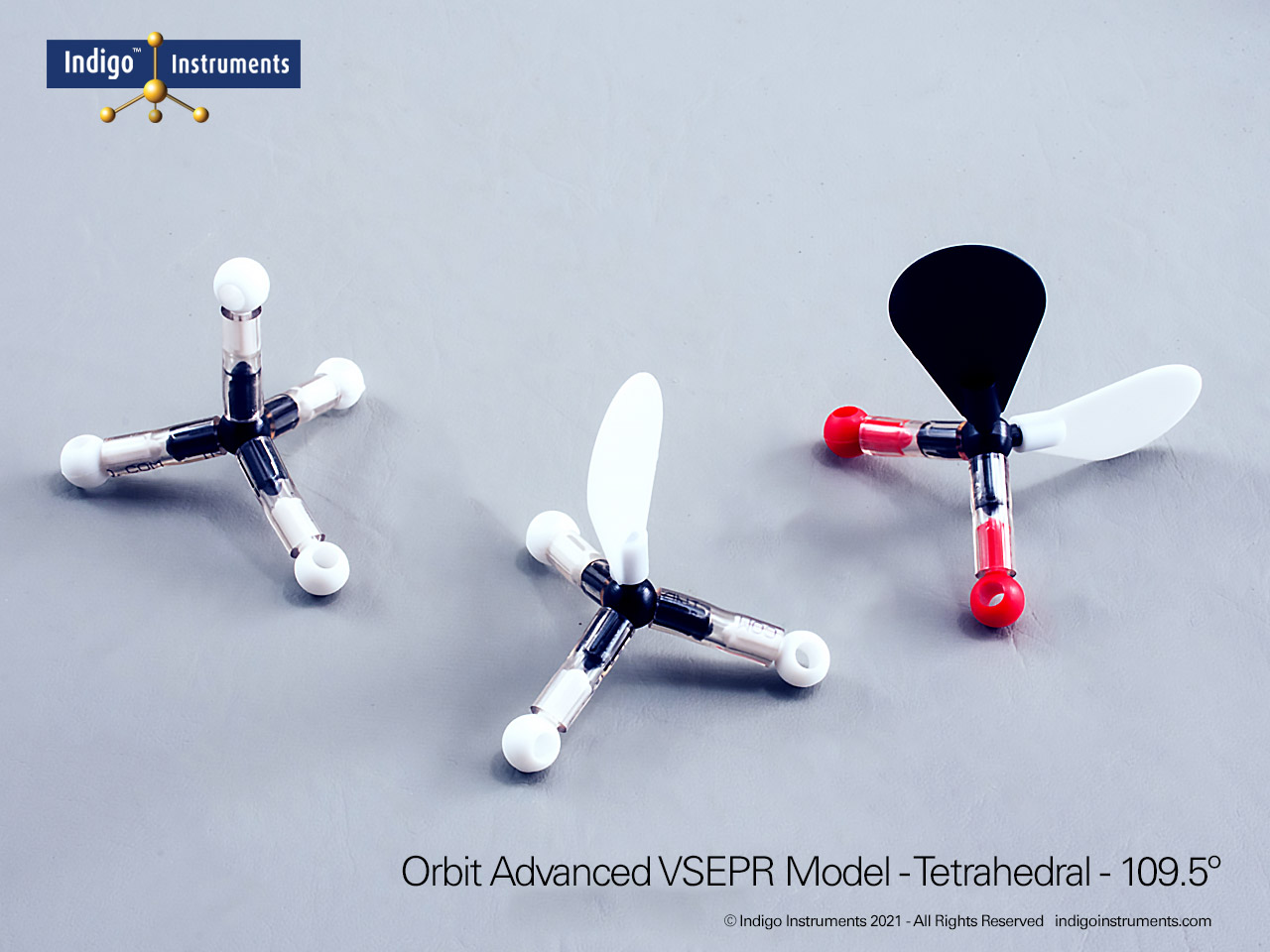
The Indigo® 68823W VSEPR model kit builds both trigonal planar AX3 and bent AX2E models simultaneously so tutors can show how a single lone pair distorts 120° geometry in BF3, SO2, and CH2O side by side.

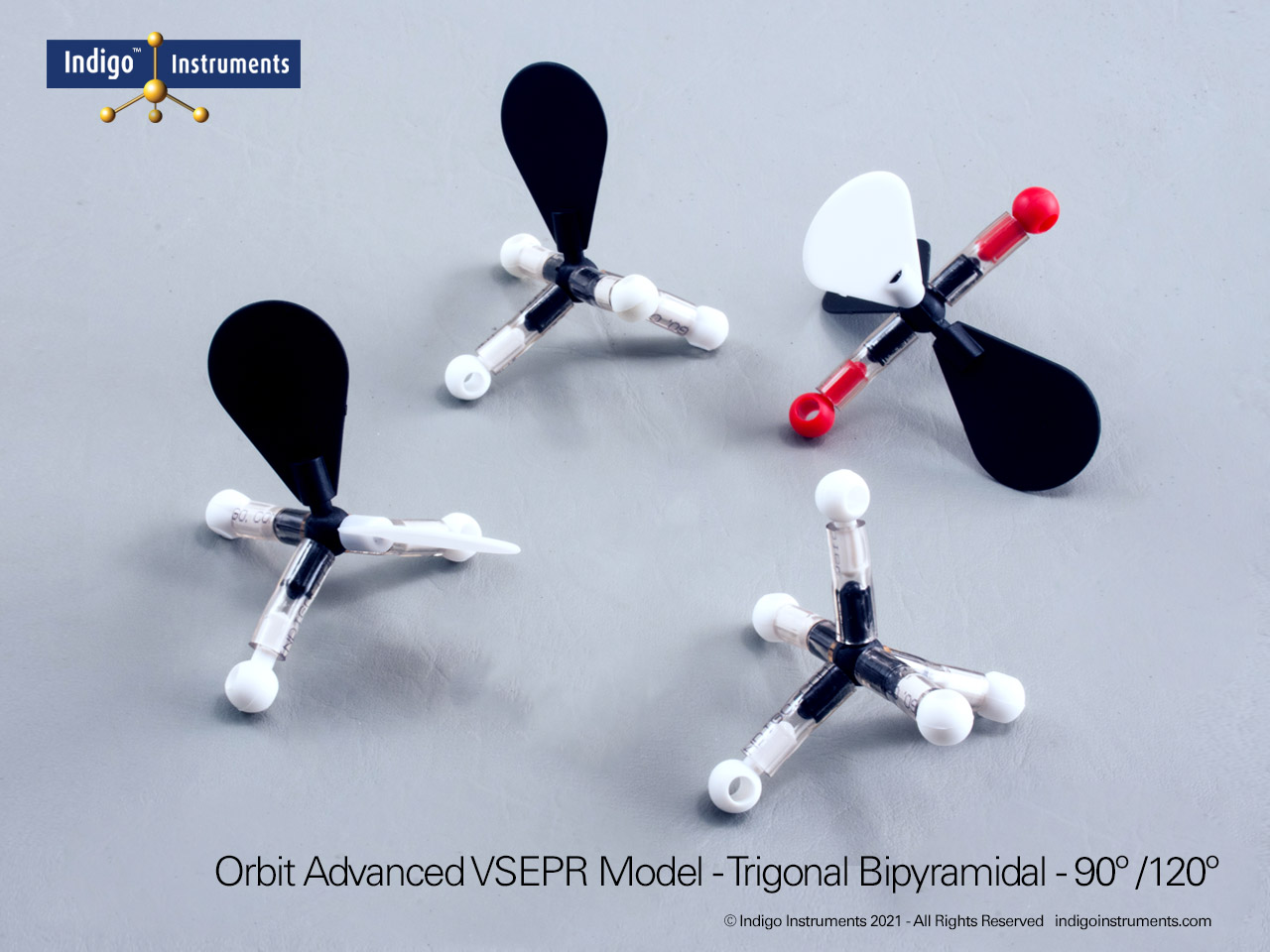
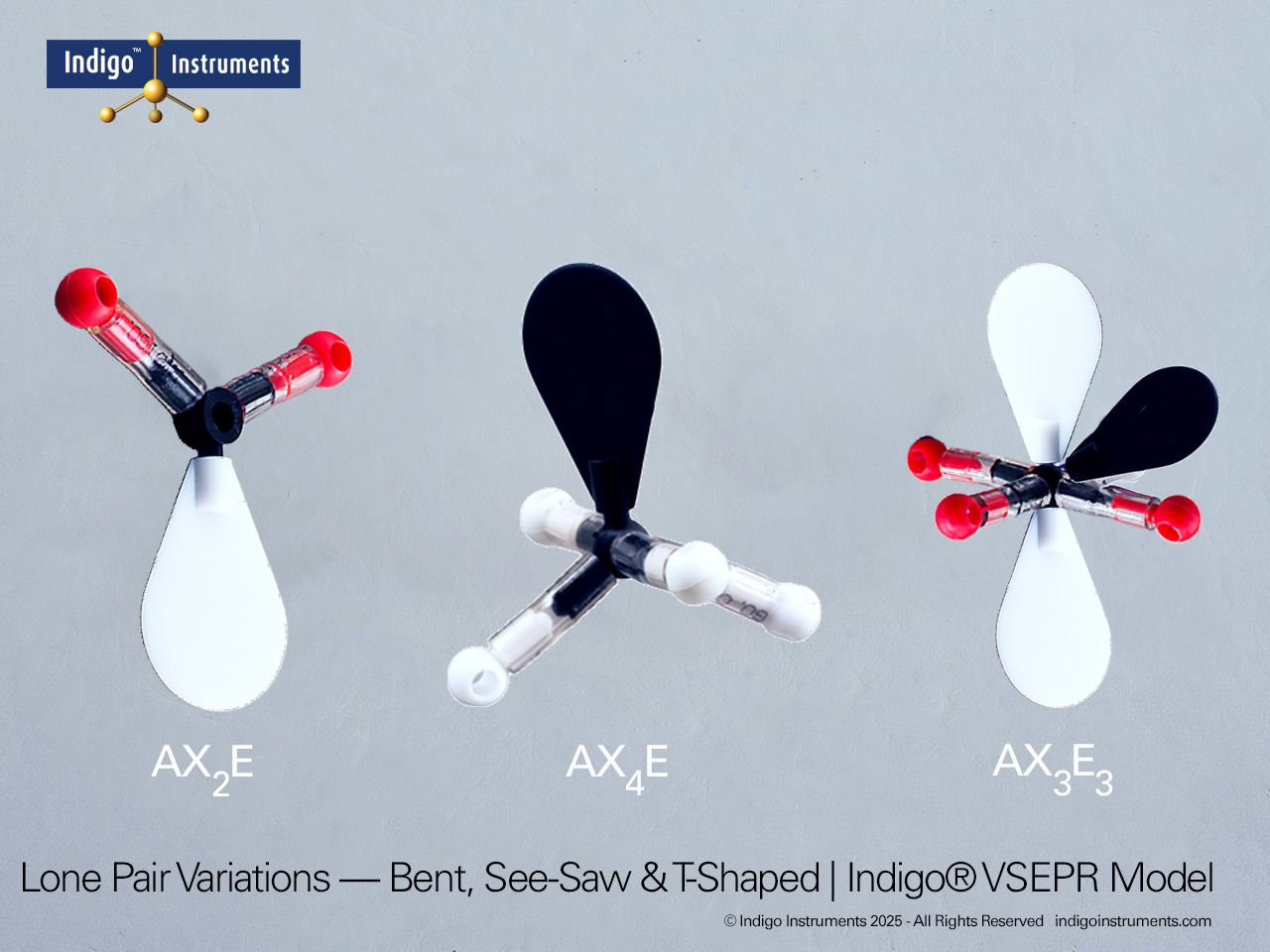
Trigonal planar geometry introduces students to electron pairs and bonding atoms sharing a single plane. The effects of replacing just one bonding atom with a lone pair is immediately clear. The Indigo® 68823W VSEPR model kit includes two trigonal planar central atoms for building AX3 and AX2E configurations simultaneously for comparison. A symmetric BF3 or SO3 model juxtaposed with a bent SO2 model makes the lone pair distortion obvious. Tutors can show the transition from 120° symmetry to the compressed geometry of AX2E, making electron domain repulsion a tangible entity. Formaldehyde (CH2O) adds a further nuance. Its trigonal planar carbon shows how double bonds count as single electron domains in VSEPR theory, connecting molecular geometry directly to bonding theory and reactivity. (Note that an actual bond needs extra parts as seen in this representation)

Details

Summary of Trigonal Shapes

Each of the two AX3 configurations produces distinct bond angles whose differences, though small, connect directly to molecular polarity and reactivity. The fully bonded AX3 arrangement achieves exact trigonal planar symmetry with all bond angles at exactly 120°. In BF3 every fluorine atom experiences identical repulsion forces, the molecule lies completely flat, and the absence of a dipole moment makes it a useful electrophile in Lewis acid-base chemistry.

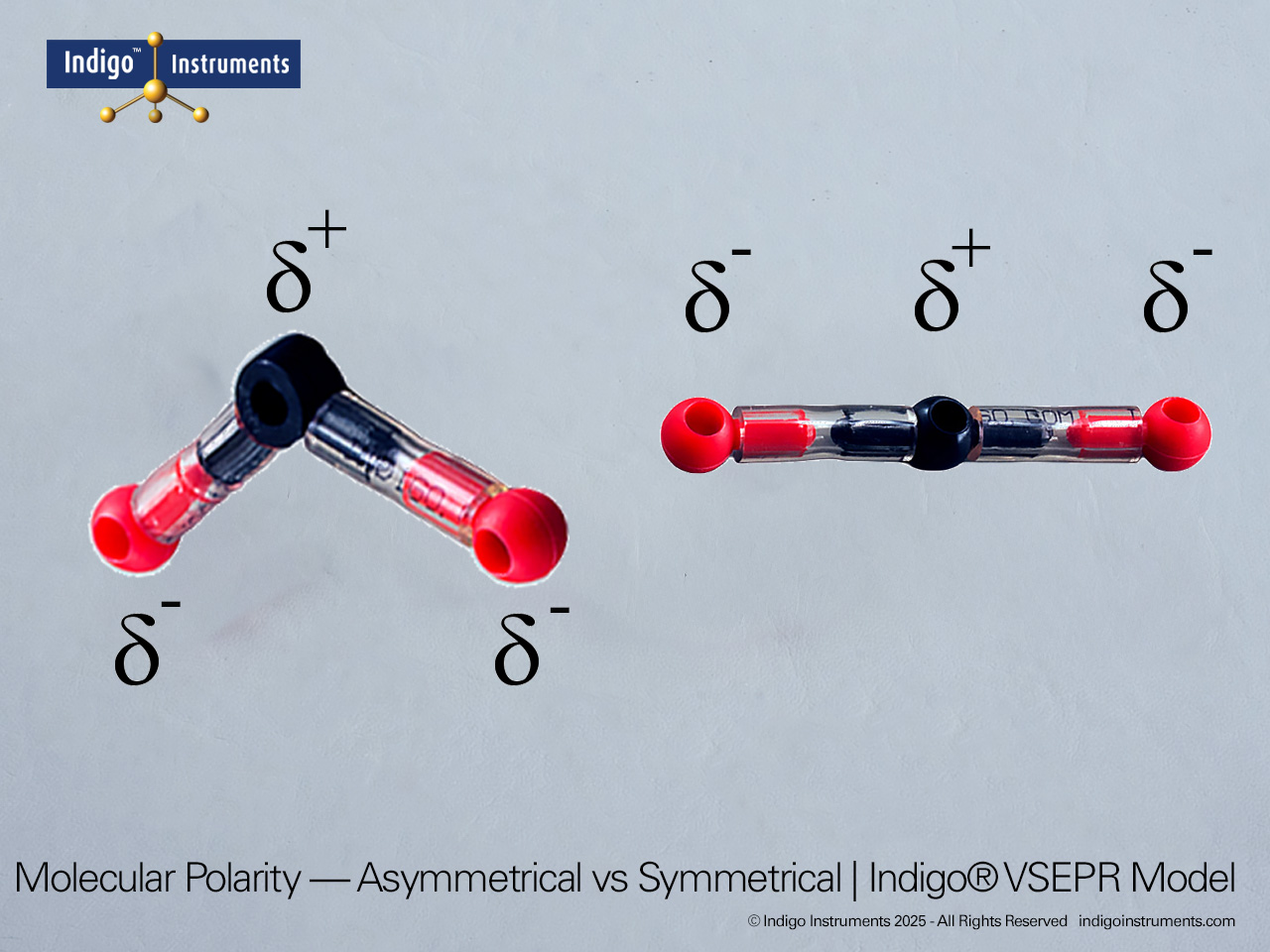
SO3 shares the same geometry and similarly has no net dipole moment despite its polar bonds. Replacing one bonding atom with a lone pair gives the bent geometry of AX2E. In SO2 the lone pair compresses the O-S-O bond angle from 120° to approximately 119°. This is a small distortion numerically but has significant consequences. Unlike SO3, sulfur dioxide has a measurable dipole moment, behaves very differently in solution, and is central to discussions of atmospheric chemistry and acid rain. The model makes the source of that asymmetry immediately visible.

Formaldehyde (CH2O) offers a third perspective on trigonal planar geometry. The central carbon forms a double bond to oxygen and two single bonds to hydrogen, and VSEPR theory treats the double bond as a single electron domain. This trigonal planar molecule has bond angles close to 120°, connecting molecular geometry directly to the concept of sp2 hybridization and opening discussion of how multiple bonds influence shape.

Related information or images
Parts
Specifications

The parts listed on this page are for the entire kit, not the molecules(s) shown. You can augment this geometry with additional pieces listed on the Orbit Components page.

Reviews ()
Review This Product Now!