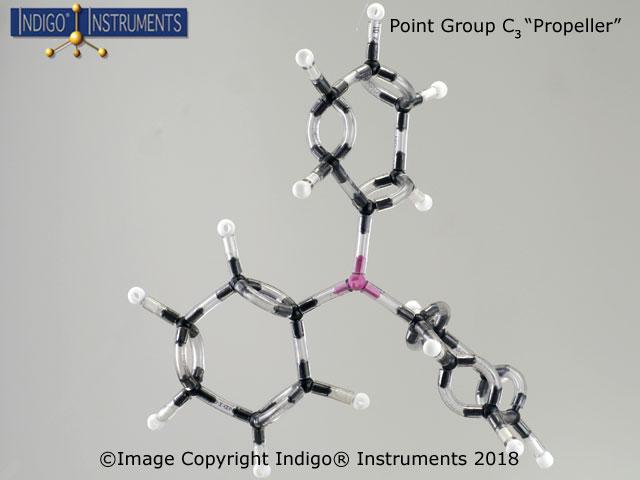
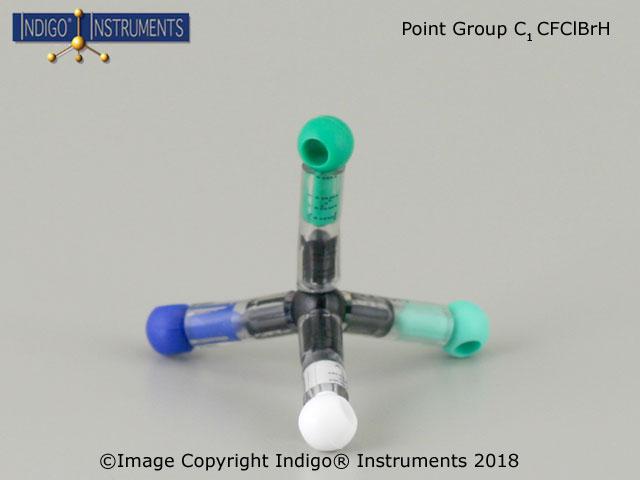
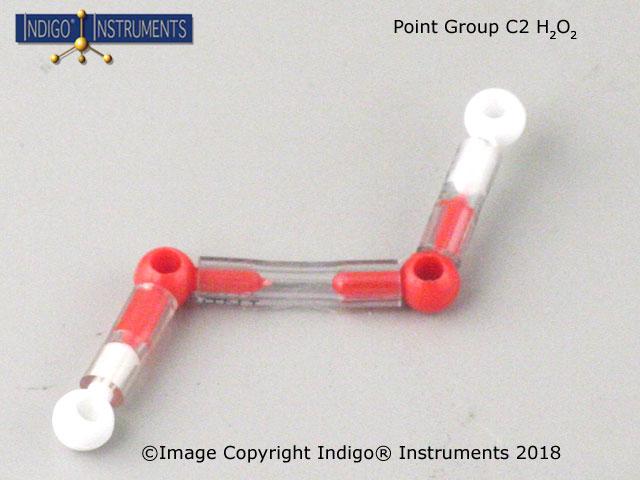
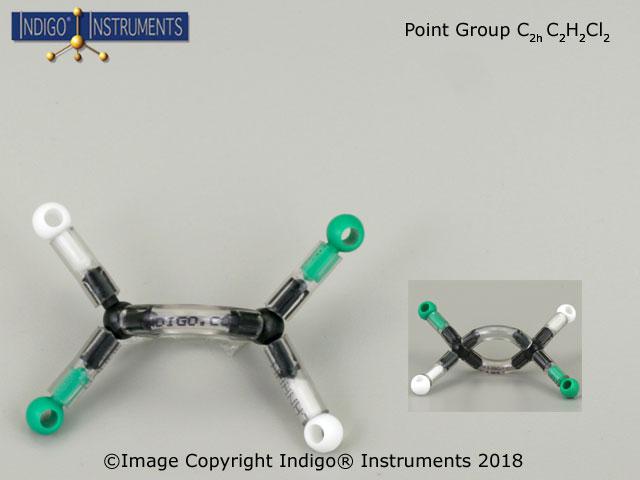
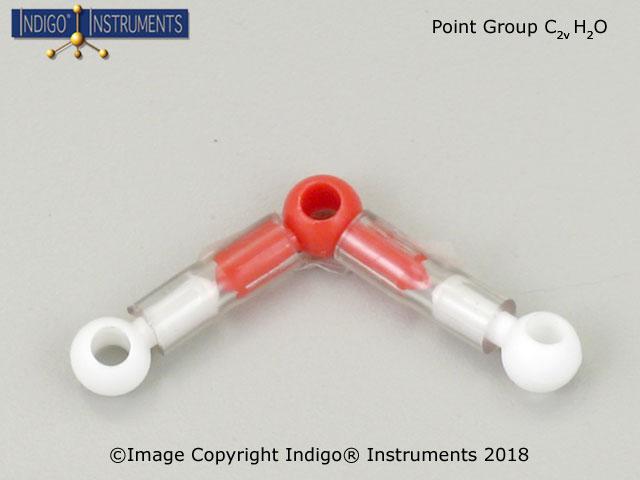
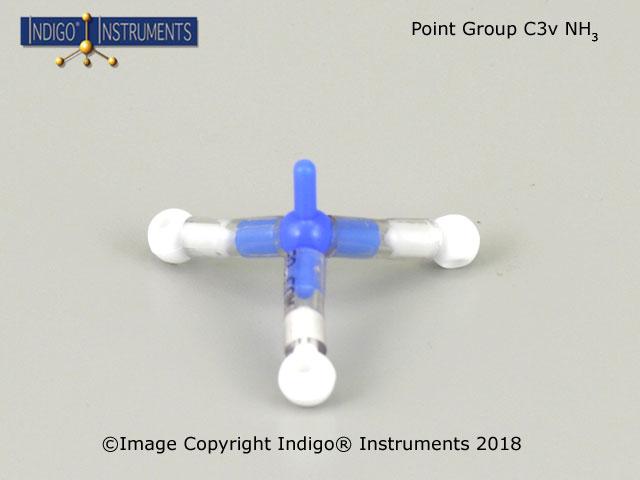
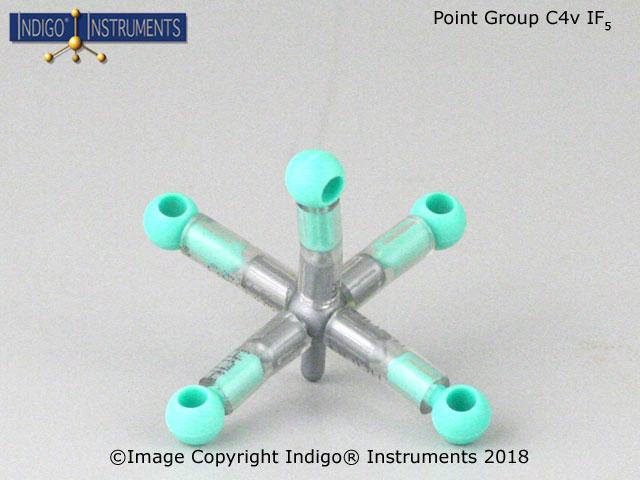
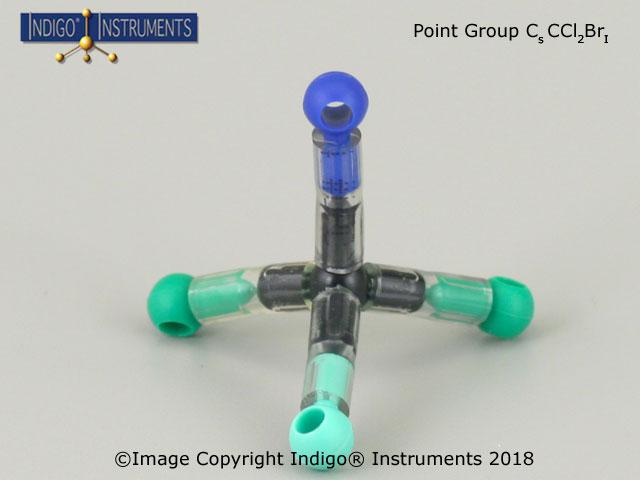
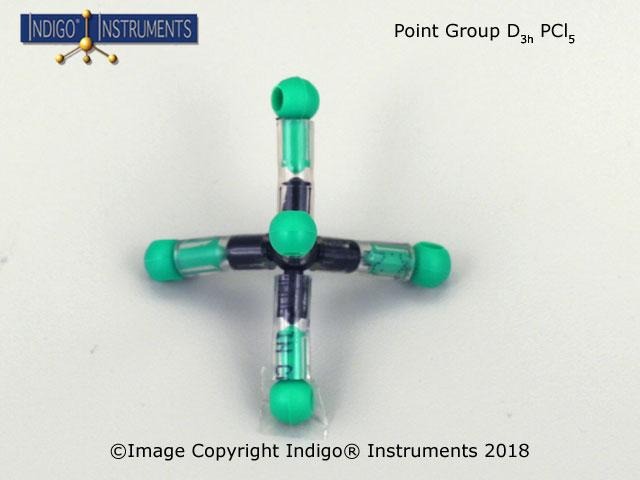
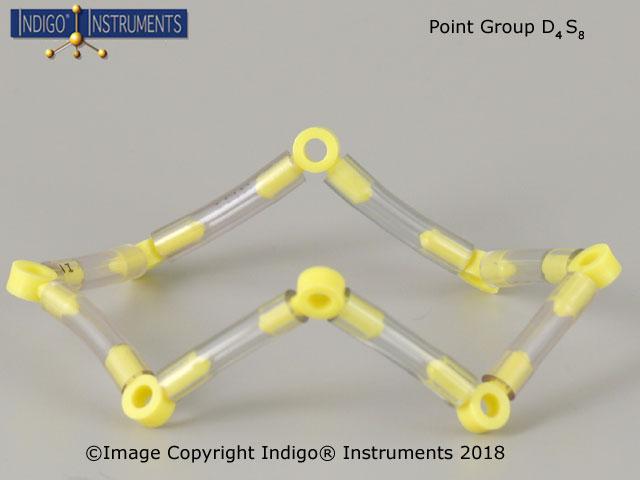
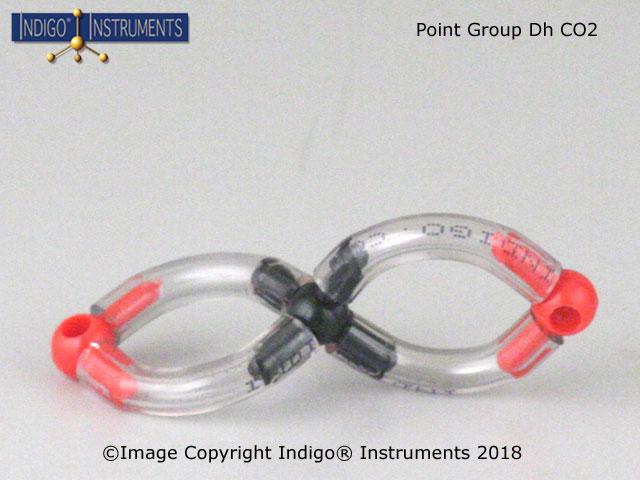
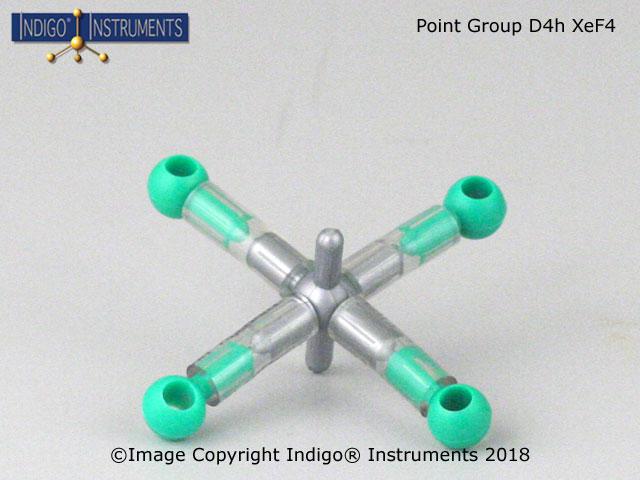
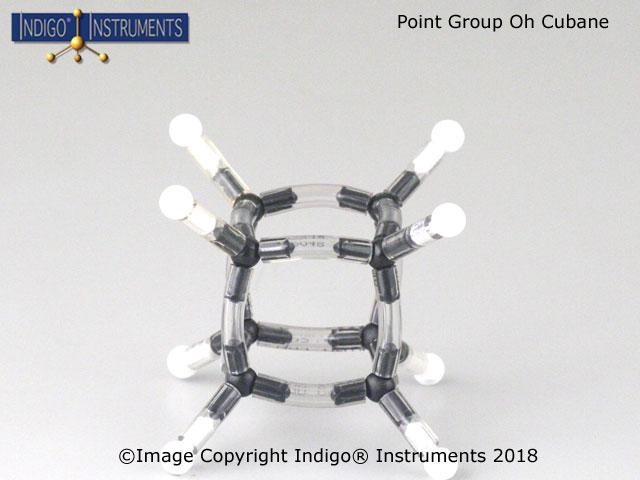
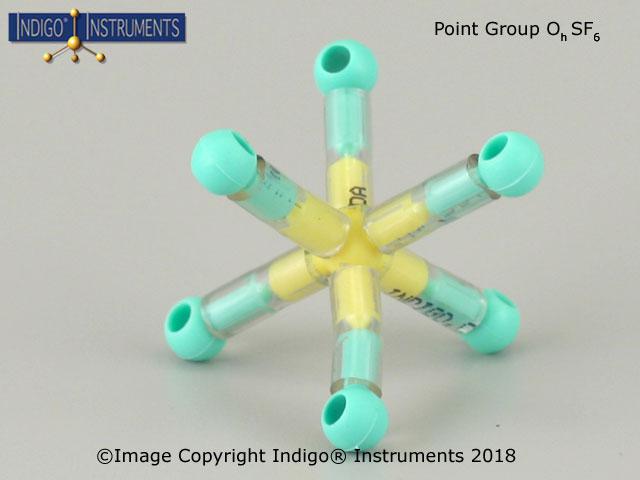
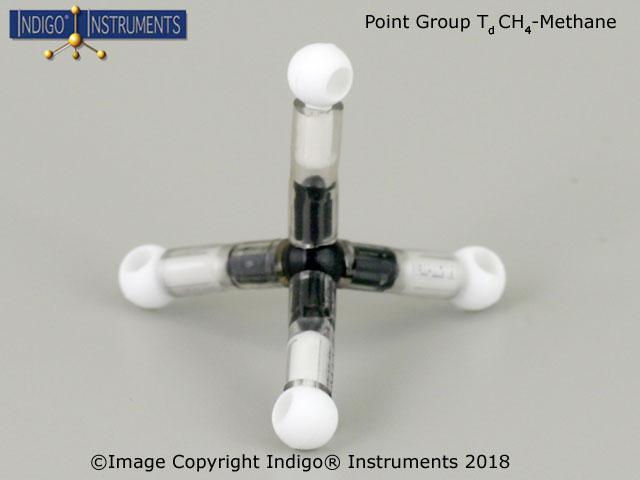
Build triphenylphosphine, PPh3, with the Indigo® 68821W molecular model kit to demonstrate C3 point group symmetry, propeller geometry, and chiral rotation. Ideal for undergraduate inorganic chemistry and graduate-level organometallic courses.
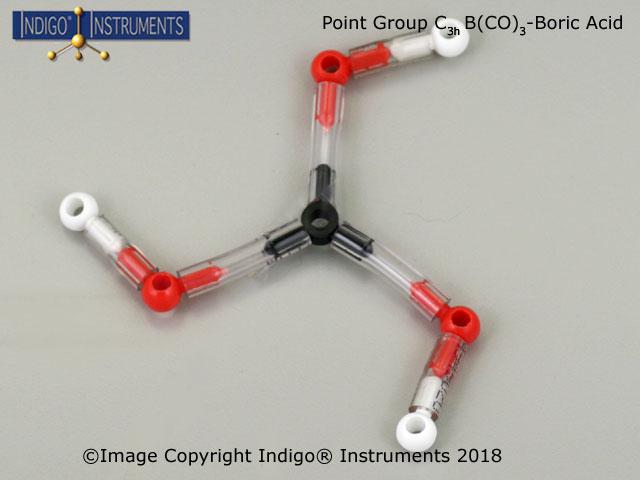
The Indigo® 68821W molecular model kit builds triphenylphosphine, PPh?, a tertiary phosphine in which three phenyl groups replace the hydrogens of phosphane around a central phosphorus atom. The completed model displays the trigonal-pyramidal shape and twisted propeller geometry characteristic of the C3 point group, making it straightforward for students to visualize why PPh? is chiral despite its apparent symmetry. Unlike the related C3h examples buildable with this kit, triphenylphosphine possesses only a C3 rotation axis with no horizontal mirror plane, placing it firmly in the chiral C3 point group.
Triphenylphosphine's molecular formula can be shown in two ways: C18H15P or (C6H5)3P.
The parts list below is for the entire kit, not just for triphenylphosphine: Option 0 incorrectly lists 50mm bonds; use the 35mm instead.
Use our 3D Molecular Model Builder to show you the chemical structure of other C3 point group examples molecules such as: phosphoric acid, triethylamine, triphenylmethane, & triphenylphosphine-oxide.
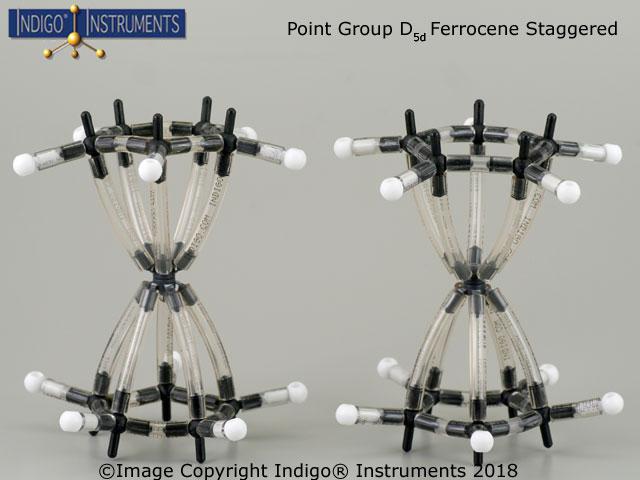
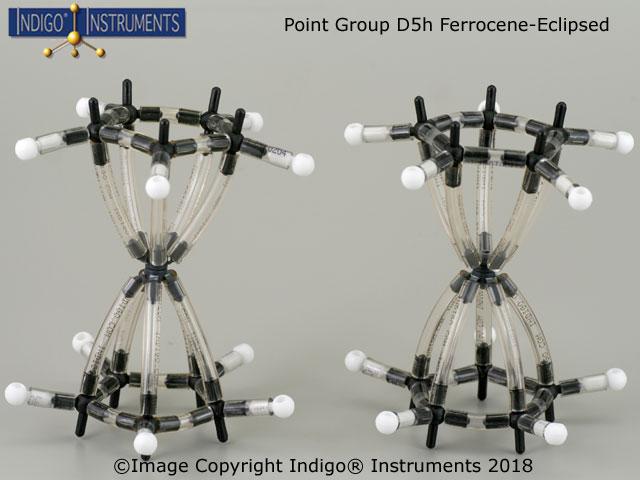
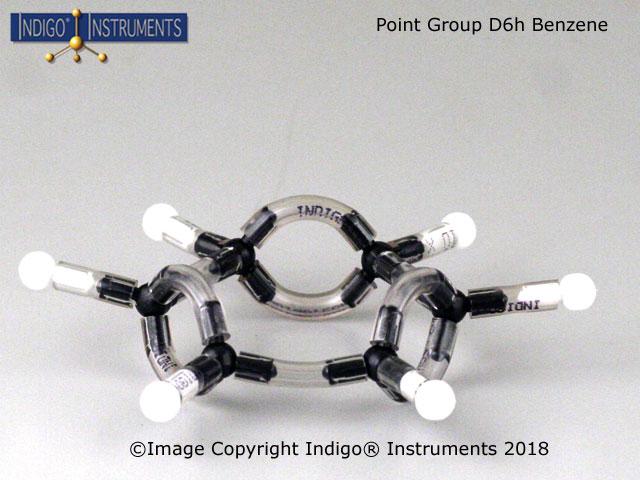
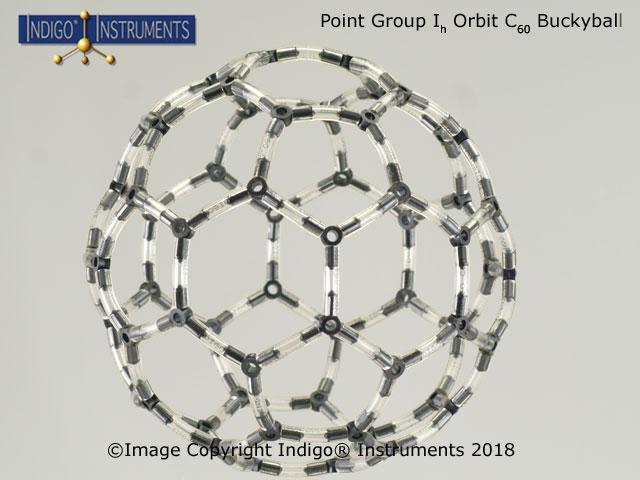
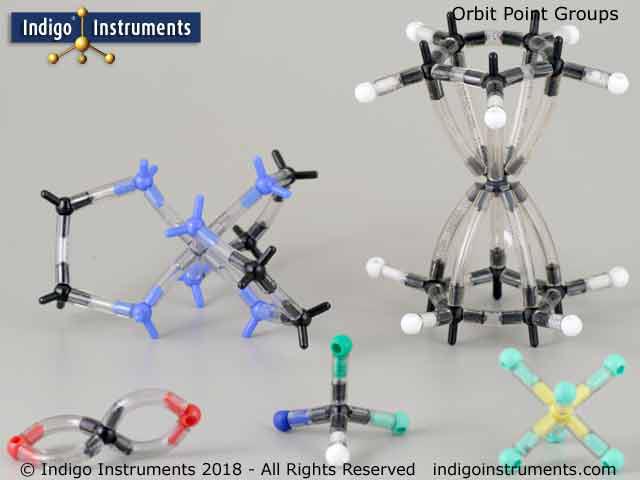
Our Orbit organic chemistry model sets can also build many point group structures as well. Set the model builder to Orbit (basic) style if have our 68845NV Foundation (basic) chemistry model set, or Orbit (flexible) if you either have our 68827W chemistry advanced organic chemistry molecular model set or the 68847W class organic-inorganic molecular model set.
If you would like to augment any of our Orbit organic sets with the extra parts needed for specific point groups, send us the details.
| P/N | Description | QTY |
|---|---|---|
| 68186-20 | Wobbly bond, 20mm, each | 104 |
| 68186-25 | Wobbly bond, 25mm, each | 10 |
| 68186-30 | Wobbly bond, 30mm, each | 52 |
| 68186-35 | Wobbly bond, 35mm, each | 39 |
| 68186-50 | Wobbly bond, 50mm, each | 10 |
| 68216C | Atom, Orbit, H "a", white, 1 prong | 95 |
| 68217C | Atom, Orbit, N "a", blue, 1 prong | 2 |
| 68219C | Atom, Orbit, F "a", light green, 1 prong | 15 |
| 68221C | Atom, Orbit, Cl "a", green, 1 prong | 16 |
| 68228C | Atom, Orbit, S "c", 100 degree, yellow | 8 |
| 68230C | Atom, Orbit, O "d", 110 degree, red | 8 |
| 68241C | Atom, Orbit, C "j", planar: 120-120-120, black | 1 |
| 68244C | Atom, Orbit, C "k", tetrahedral, black | 50 |
| 68245C | Atom, Orbit, N "k", tetrahedral, blue | 8 |
| 68247C | Atom, Orbit, P "k", tetrahedral, purple | 1 |
| 68255C | Atom, Orbit, S "l", octahedral, yellow | 1 |
| 68258C | Atom, Orbit "l", octahedral, grey | 3 |
| 68259C | Atom, Orbit, C "m", trigonal bipyramidal, black | 11 |
| 68505C | 2 |
This model set has the flexibility needed to teach symmetry point groups effectively, as well as modeling metal coordination complexes. Some atoms have holes perpendicular to their main bonds, allowing for modeling H-bonds or electrostatic interactions. Construction-wise, atoms pieces are smaller relative to the bond pieces, emphasizing the relative space taken up by orbitals compared to nuclei. However, this can also make it difficult to change molecular structure quickly. Indigo Instruments customer service was also very helpful in processing my order quickly and completing forms required by my institution for requisition.
For each Related Product, enter the quantity you would like to order and click the Add to Cart button beside the item.
Thanks for the feedback. It is an unusual set & the only one we know of that can build ferrocene.