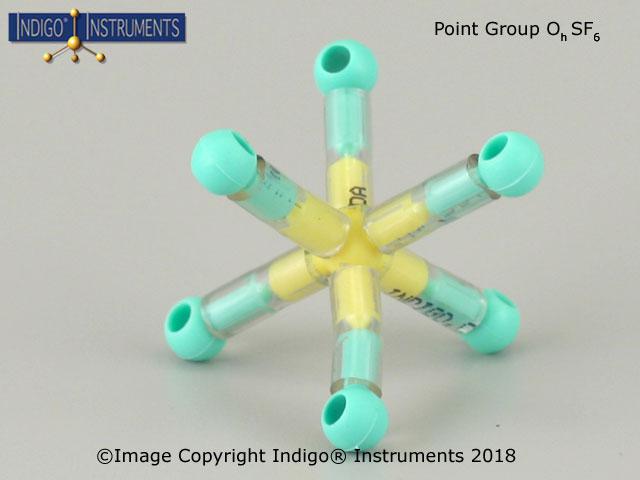
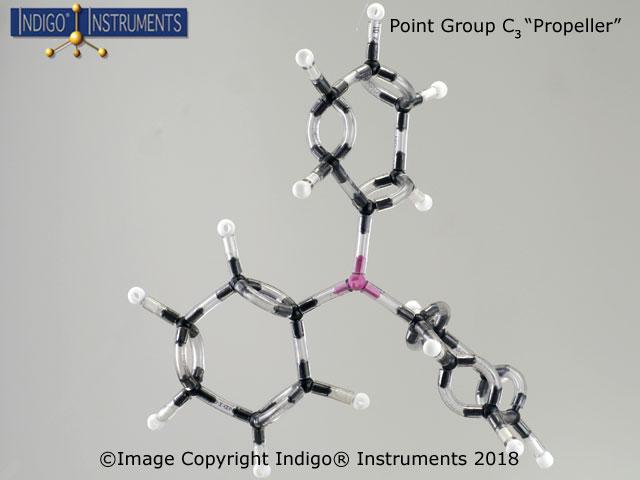
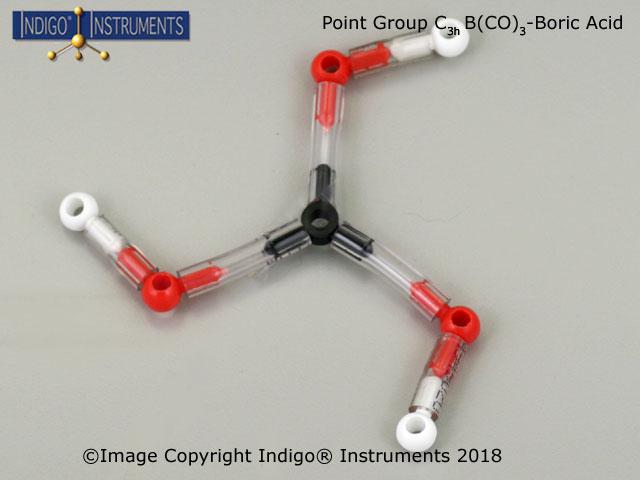
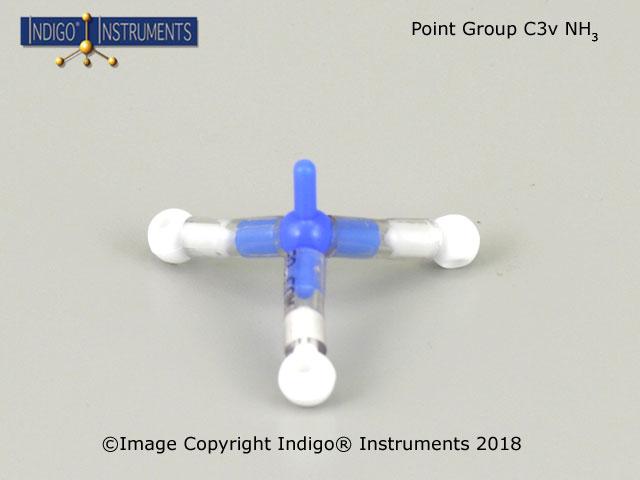
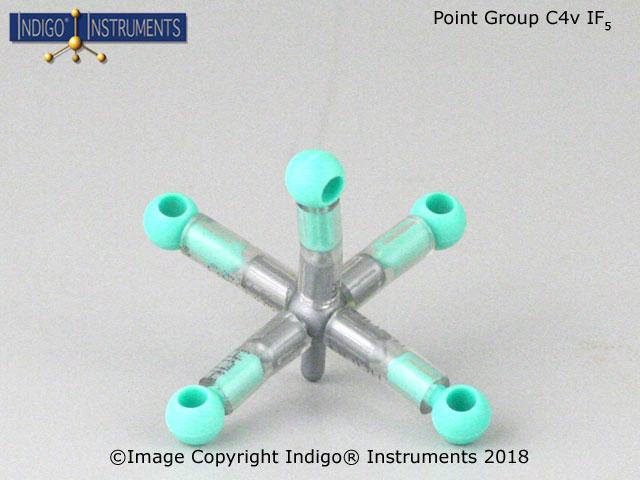
Build sulfur hexafluoride, SF6, with the Indigo® 68821W point group molecular model kit to demonstrate Oh inversion symmetry & octahedral geometry. This kit is ideal for symmetry, group theory, and advanced inorganic chemistry courses.
The Indigo® 68821W model kit builds sulfur hexafluoride, SF6, as an example of the Oh point group. The model identifies all the symmetry elements. This includes the identity operation E, three mutually perpendicular C4 axes through two opposite fluorine atoms and four C3 axes through opposite triangular faces of the octahedron. In addition, it show six C2 axes through opposite edge midpoints, the horizontal mirror plane σh, and six additional mirror planes. Lastly, the model shows the improper rotation axes S4 and S6 and a center of inversion i. SF6 is one of the highest symmetry molecules encountered in undergraduate chemistry with 48 symmetry operations in total. Other Oh molecules include molybdenum hexacarbonyl Mo(CO)6, uranium hexafluoride UF6, and the hexachloroplatinate ion PtCl62-.
The Oh point group represents the highest symmetry commonly encountered in molecular chemistry, and SF6 is its most instructive main group example. Its octahedral geometry places all six fluorine atoms in equivalent positions, and every F-S-F angle is exactly 90° or 180°. This equivalence is immediately apparent in the physical model and connects Oh symmetry assignment directly to the VSEPR and AX6 discussion of octahedral geometry. SF6 is also a hypervalent molecule requiring twelve electrons around the central sulfur atom, making it a productive starting point for discussing expanded octets and the limits of the octet rule alongside its symmetry properties. It has remarkable chemical inertness because the fluorine atoms completely shield the central sulfur from nucleophilic attack. This makes it one of the most industrially significant molecules in this symmetry class.
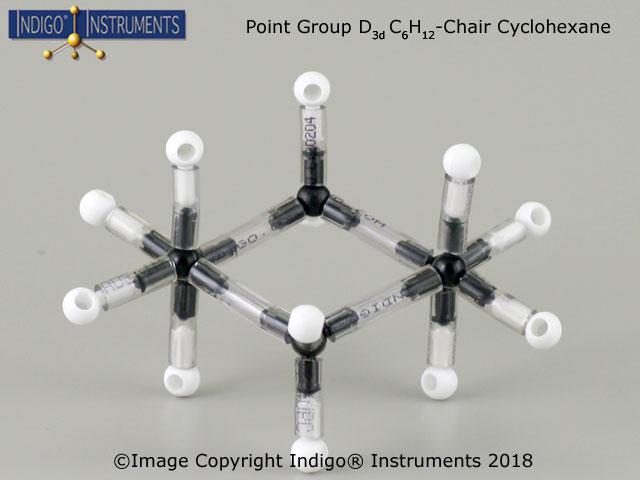
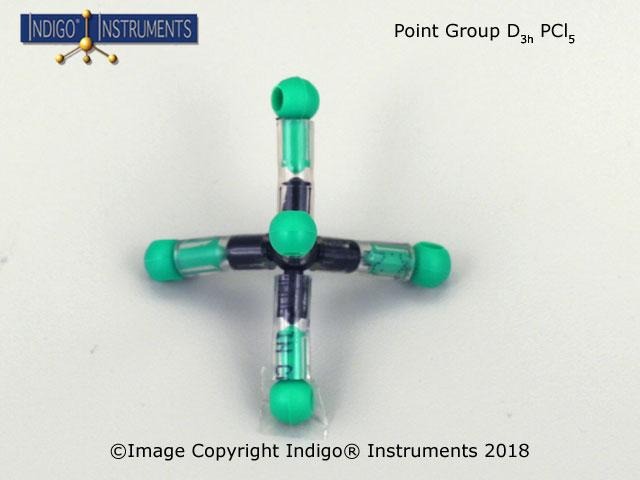
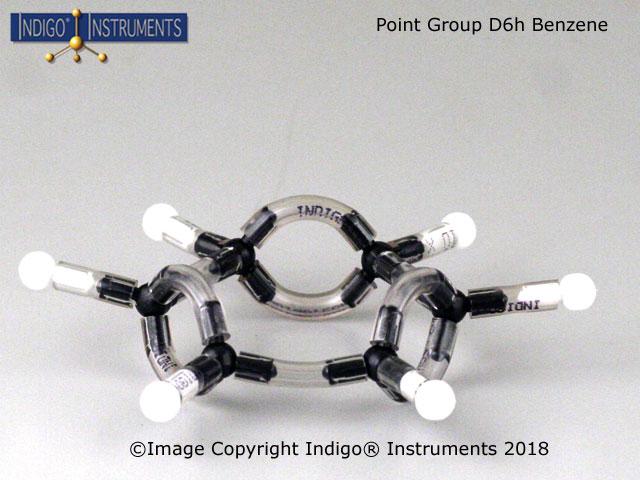
The SF6 inversion center places it among the centrosymmetric point groups. Its IR active vibrational modes are Raman inactive and vice versa in accordance with the mutual exclusion rule. SF6 has fifteen vibrational modes in total yet only four are IR active. This is a consequence of its high Oh symmetry and is memorable as the equivalent for benzene in D6h. The transition metal carbonyl Mo(CO)6 shares Oh symmetry and extends the point group into organometallic chemistry. Here, the CO stretching modes and their symmetry species are a standard topic in advanced inorganic and spectroscopy courses. The Oh SF6 model pairs most directly with the D3h PCl5 model to illustrate how adding a further pair of axial substituents to a hypervalent main group molecule elevates symmetry from D3h to the full octahedral group.
Indigo Instruments has held inventory of genuine Cochranes of Oxford (Orbit) parts for 30+ years (see "Skeletal (Orbit/Minit)) that are compatible with every molecular model set/kit we have sold since day 1. You can by these parts to augment/upgrade Orbit style student organic chemistry model sets 68845NV or 68827W to build any point group. Chemistry stores or clubs can buy in bulk for savings.
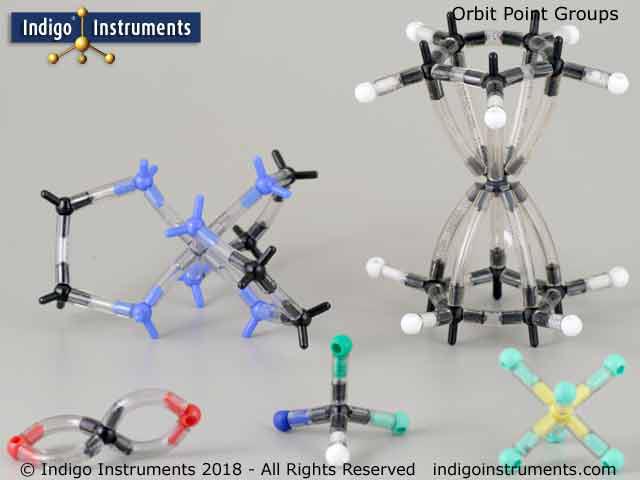
The 68845NV Foundation (basic) chemistry model set and the 68827W chemistry advanced organic chemistry molecular model set can build some of the point groups shown above as can the 68847W class organic-inorganic molecular model set. These sets can be customized for other courses in inorganic chemistry & biochemistry. Contact us with your details. Minimum order quantities may apply.
Note: the parts listed below apply to the entire kit not the specific model referred to on this page.
| P/N | Description | QTY |
|---|---|---|
| 68186-20 | Wobbly bond, 20mm, each | 104 |
| 68186-25 | Wobbly bond, 25mm, each | 10 |
| 68186-30 | Wobbly bond, 30mm, each | 52 |
| 68186-35 | Wobbly bond, 35mm, each | 39 |
| 68186-50 | Wobbly bond, 50mm, each | 10 |
| 68216C | Atom, Orbit, H "a", white, 1 prong | 95 |
| 68217C | Atom, Orbit, N "a", blue, 1 prong | 2 |
| 68219C | Atom, Orbit, F "a", light green, 1 prong | 15 |
| 68221C | Atom, Orbit, Cl "a", green, 1 prong | 16 |
| 68228C | Atom, Orbit, S "c", 100 degree, yellow | 8 |
| 68230C | Atom, Orbit, O "d", 110 degree, red | 8 |
| 68241C | Atom, Orbit, C "j", planar: 120-120-120, black | 1 |
| 68244C | Atom, Orbit, C "k", tetrahedral, black | 50 |
| 68245C | Atom, Orbit, N "k", tetrahedral, blue | 8 |
| 68247C | Atom, Orbit, P "k", tetrahedral, purple | 1 |
| 68255C | Atom, Orbit, S "l", octahedral, yellow | 1 |
| 68258C | Atom, Orbit "l", octahedral, grey | 3 |
| 68259C | Atom, Orbit, C "m", trigonal bipyramidal, black | 11 |
| 68505C | 2 |
Many thanks to Alyssa Doue of Mt. St. Vincent University in Halifax, Nova Scotia who says: "I've built the point groups and they're awesome!" Click on her Google Review for more.
This model set has the flexibility needed to teach symmetry point groups effectively, as well as modeling metal coordination complexes. Some atoms have holes perpendicular to their main bonds, allowing for modeling H-bonds or electrostatic interactions. Construction-wise, atoms pieces are smaller relative to the bond pieces, emphasizing the relative space taken up by orbitals compared to nuclei. However, this can also make it difficult to change molecular structure quickly. Indigo Instruments customer service was also very helpful in processing my order quickly and completing forms required by my institution for requisition.
Sulfur hexafluoride belongs to the Oh point group which has octahedral symmetry.
The Oh point group contains 48 symmetry operations in total, including the identity (E), three C4 axes, four C3 axes, six C2 axes, three σh planes, six σd planes, an inversion center (i), S4 and S6 improper rotation axes. It is the highest symmetry point group commonly encountered in inorganic chemistry and represents the full symmetry of a perfect octahedron.
SF6 has six identical fluorine atoms arranged symmetrically around a central sulfur in a perfect octahedron, with F–S–F bond angles of exactly 90° and 180°. All six fluorines are equivalent by symmetry, the molecule has an inversion center, and its geometry satisfies all 48 symmetry operations of Oh, making it the textbook example of octahedral symmetry.
Because SF6 has an inversion center, the rule of mutual exclusion applies, no vibrational mode can be simultaneously IR and Raman active. Of its 15 vibrational modes, only the IR active modes involve changes in dipole moment and only the Raman active modes involve changes in polarizability, with neither set overlapping. This clean separation makes SF6 a valuable reference compound in vibrational spectroscopy.
The six fluorine atoms in SF6 form a highly symmetrical shell around the central sulfur that sterically shields it from nucleophilic attack, while the strong S-F bonds (bond energy ~327 kJ/mol) make thermodynamic decomposition unfavorable under normal conditions. This combination of steric protection and thermodynamic stability, both directly related to its perfect Oh symmetry, makes SF6 exceptionally inert and useful as an electrical insulator in high-voltage equipment.
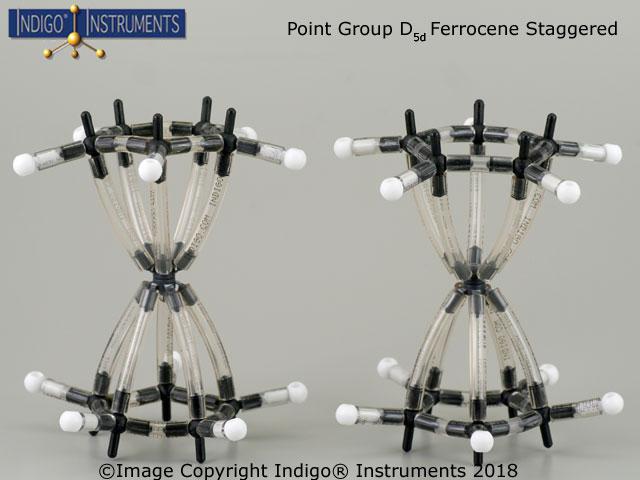
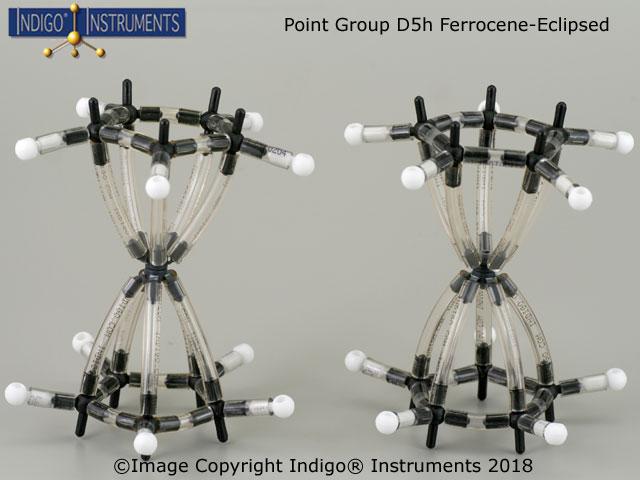
Thanks for the feedback. It is an unusual set & the only one we know of that can build ferrocene.