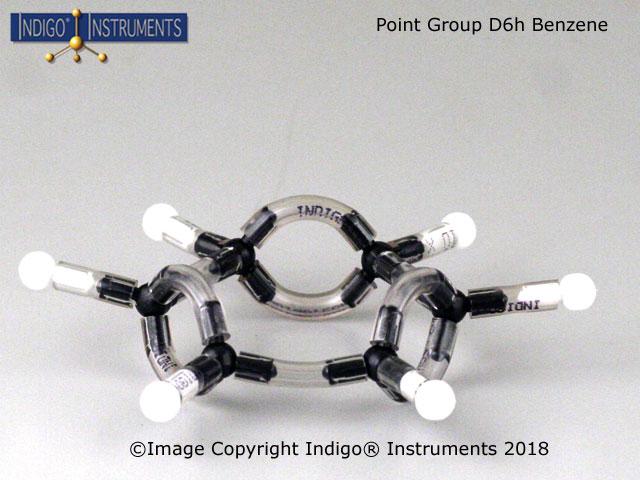
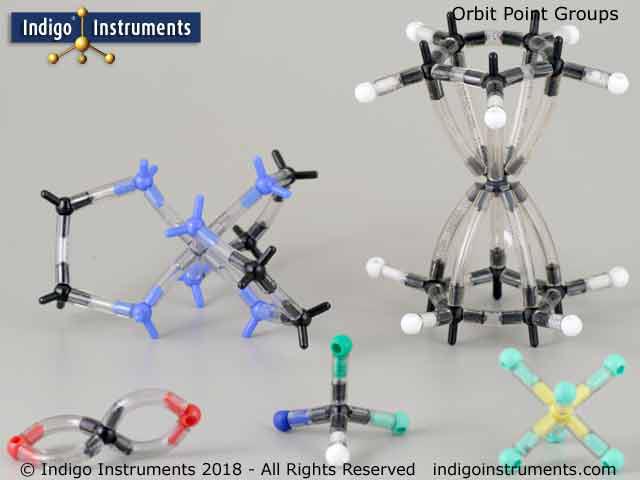
Build benzene, C6H6, with the Indigo® 68821W point group molecular model kit to show D6h point group symmetry, hexagonal planar geometry, and inversion symmetry. Ideal for undergraduate and advanced inorganic chemistry and spectroscopy courses.
The Indigo® 68821W model of benzene (C6H6) has D6h point group's hexagonal planar geometry. The model shows the principal C6 axis with coincident S6 and S3 axes, six perpendicular C2 axes, a horizontal mirror plane σh, three vertical mirror planes σv, three dihedral mirror planes σd, and a center of inversion i. Benzene is a high-symmetry molecule routinely encountered in undergraduate chemistry. Other D6h molecules include coronene and hexafluorobenzene.
The D6h point group is among the highest-symmetry molecular point groups covered in undergraduate and advanced inorganic chemistry, and benzene is its definitive example. As a centrosymmetric molecule, benzene obeys the mutual exclusion rule strictly. Its IR active vibrational modes are Raman inactive and vice versa which makes it a standard case study in vibrational spectroscopy courses. This is useful for discussing selection rules, symmetry species assignments, and the reduction of a large number of vibrational modes to a small number of observable bands.
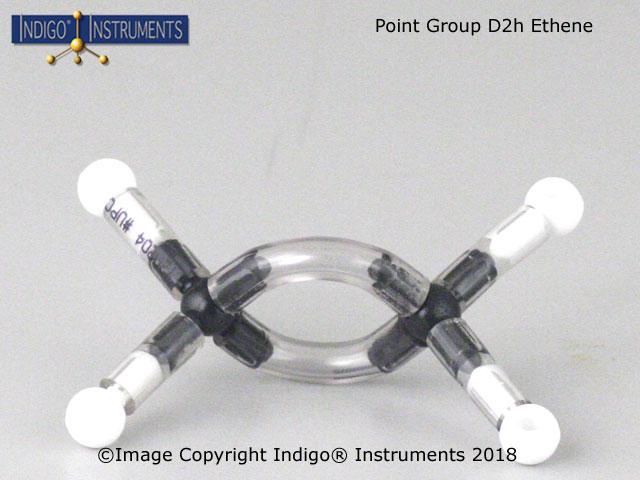
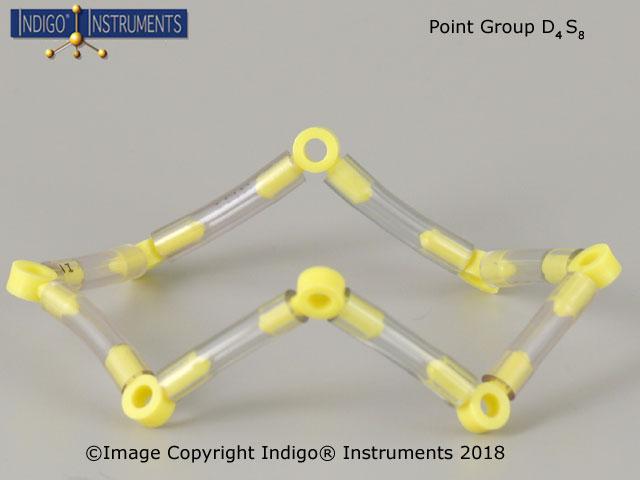
Benzene has thirty vibrational modes in total, yet only four are IR active, a consequence of its high D6h symmetry that students find striking and memorable when working through character table analysis. In advanced inorganic and solid state chemistry, the D6h point group appears in the context of graphene and graphite layer symmetry, metallocenes such as bis(benzene)chromium, and the crystallographic analysis of hexagonal close-packed structures. For instructors assembling a complete point group model series, the D6h benzene model represents the highest-symmetry example in the 68821W model kit and pairs productively with the D2h ethene and D4d S8 models to illustrate how increasing rotational symmetry progressively restricts the number of spectroscopically active vibrational modes.
Indigo Instruments has held inventory of genuine Cochranes of Oxford (Orbit) parts for 30+ years (see "Skeletal (Orbit/Minit)) that are compatible with every molecular model set/kit we have sold since day 1. This level of quality may appear expensive but no parts support from other vendors costs even more.
The 68845NV Foundation (basic) chemistry model set and the 68827W chemistry advanced organic chemistry molecular model set can build some of the point groups shown above as can the 68847W class organic-inorganic molecular model set. These sets can be customized for other courses in inorganic chemistry & biochemistry. Contact us with your details. Minimum order quantities may apply.
Note: the parts listed below apply to the entire kit not the specific model referred to on this page.
| P/N | Description | QTY |
|---|---|---|
| 68186-20 | Wobbly bond, 20mm, each | 104 |
| 68186-25 | Wobbly bond, 25mm, each | 10 |
| 68186-30 | Wobbly bond, 30mm, each | 52 |
| 68186-35 | Wobbly bond, 35mm, each | 39 |
| 68186-50 | Wobbly bond, 50mm, each | 10 |
| 68216C | Atom, Orbit, H "a", white, 1 prong | 95 |
| 68217C | Atom, Orbit, N "a", blue, 1 prong | 2 |
| 68219C | Atom, Orbit, F "a", light green, 1 prong | 15 |
| 68221C | Atom, Orbit, Cl "a", green, 1 prong | 16 |
| 68228C | Atom, Orbit, S "c", 100 degree, yellow | 8 |
| 68230C | Atom, Orbit, O "d", 110 degree, red | 8 |
| 68241C | Atom, Orbit, C "j", planar: 120-120-120, black | 1 |
| 68244C | Atom, Orbit, C "k", tetrahedral, black | 50 |
| 68245C | Atom, Orbit, N "k", tetrahedral, blue | 8 |
| 68247C | Atom, Orbit, P "k", tetrahedral, purple | 1 |
| 68255C | Atom, Orbit, S "l", octahedral, yellow | 1 |
| 68258C | Atom, Orbit "l", octahedral, grey | 3 |
| 68259C | Atom, Orbit, C "m", trigonal bipyramidal, black | 11 |
| 68505C | 2 |
Many thanks to Alyssa Doue of Mt. St. Vincent University in Halifax, Nova Scotia who says: "I've built the point groups and they're awesome!" Click on her Google Review for more.
This model set has the flexibility needed to teach symmetry point groups effectively, as well as modeling metal coordination complexes. Some atoms have holes perpendicular to their main bonds, allowing for modeling H-bonds or electrostatic interactions. Construction-wise, atoms pieces are smaller relative to the bond pieces, emphasizing the relative space taken up by orbitals compared to nuclei. However, this can also make it difficult to change molecular structure quickly. Indigo Instruments customer service was also very helpful in processing my order quickly and completing forms required by my institution for requisition.
The D6h point group contains the identity (E), a principal C6 axis, six C2 axes perpendicular to it, a horizontal mirror plane (σh), three vertical mirror planes (σv), three dihedral mirror planes (σd), an inversion center (i), and S6 and S3 improper rotation axes. It is one of the highest symmetry point groups encountered in organic chemistry and contains 24 symmetry operations in total.
Benzene is a planar, regular hexagonal molecule with six equivalent C–H units related by a C6 axis perpendicular to the molecular plane. The molecular plane itself serves as σh, six C2 axes lie in the molecular plane, and the combination of these elements with the inversion center and multiple mirror planes places benzene firmly in D6h, the highest symmetry point group for a planar hexagonal molecule.
Benzene's inversion center means the rule of mutual exclusion applies. no vibrational mode can be both IR and Raman active. Of benzene's 30 vibrational modes, many are degenerate due to its high symmetry, and the iconic C=C stretching mode at ~992 cm-1 is Raman active but IR inactive, making Raman spectroscopy essential for its full vibrational characterization.
Any substitution that breaks the equivalence of the six carbon positions lowers the symmetry below D6h. Monosubstitution gives C2v, 1,4-disubstitution with identical groups gives D2h, and 1,3,5-trisubstitution with identical groups gives D3h. This systematic reduction in symmetry upon substitution is a powerful illustration of how molecular structure determines point group assignment.
Thanks for the feedback. It is an unusual set & the only one we know of that can build ferrocene.