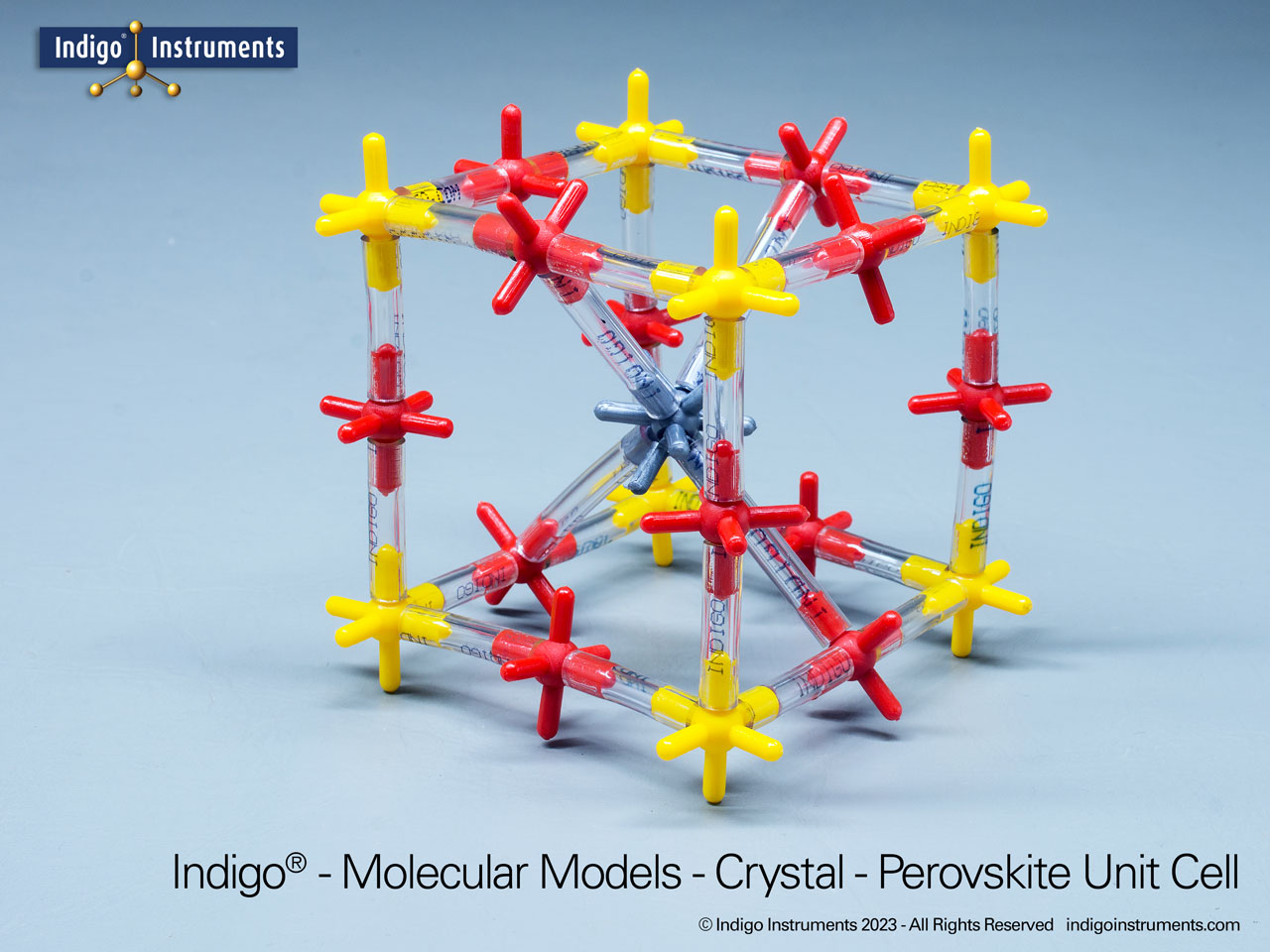
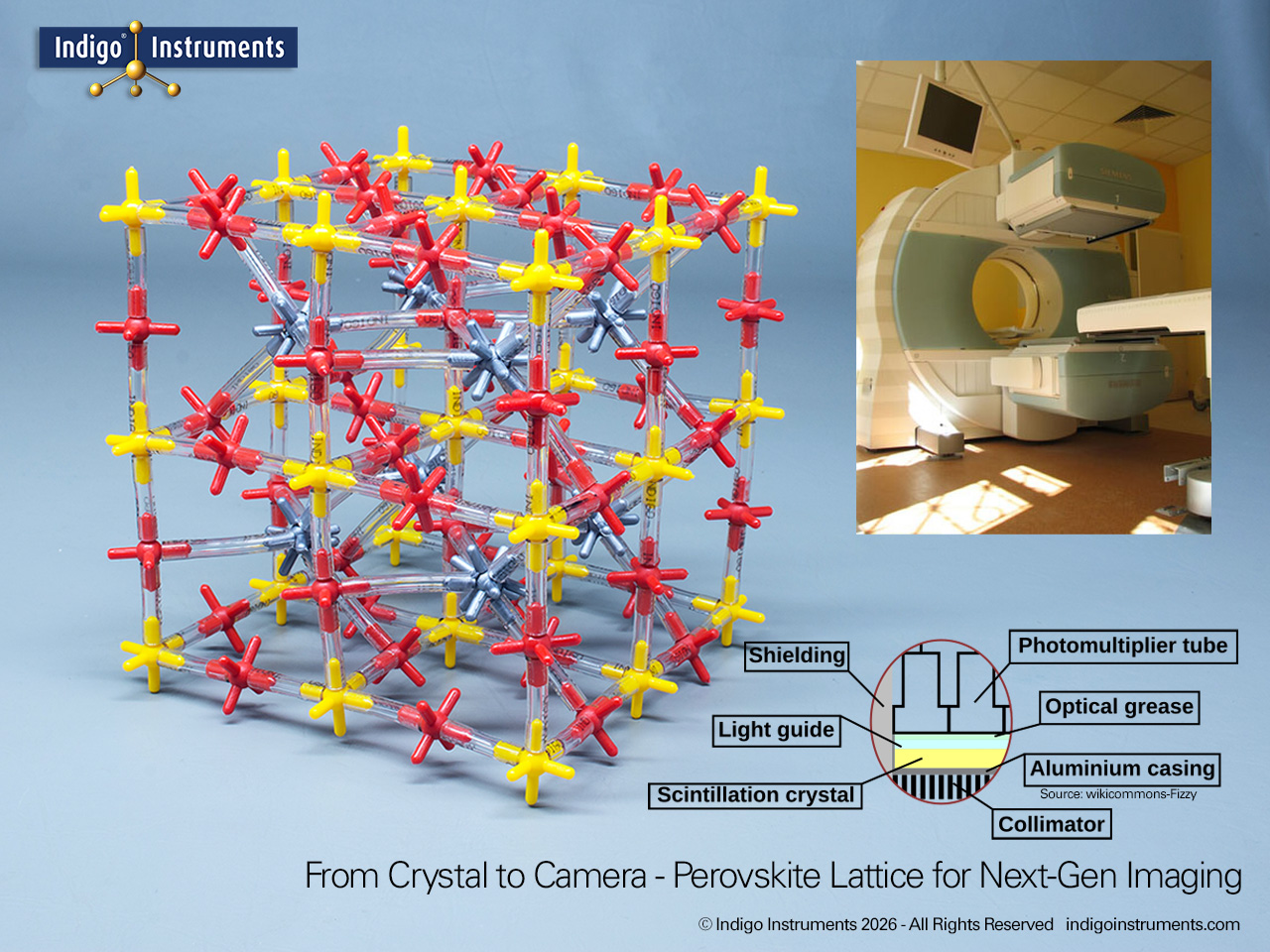
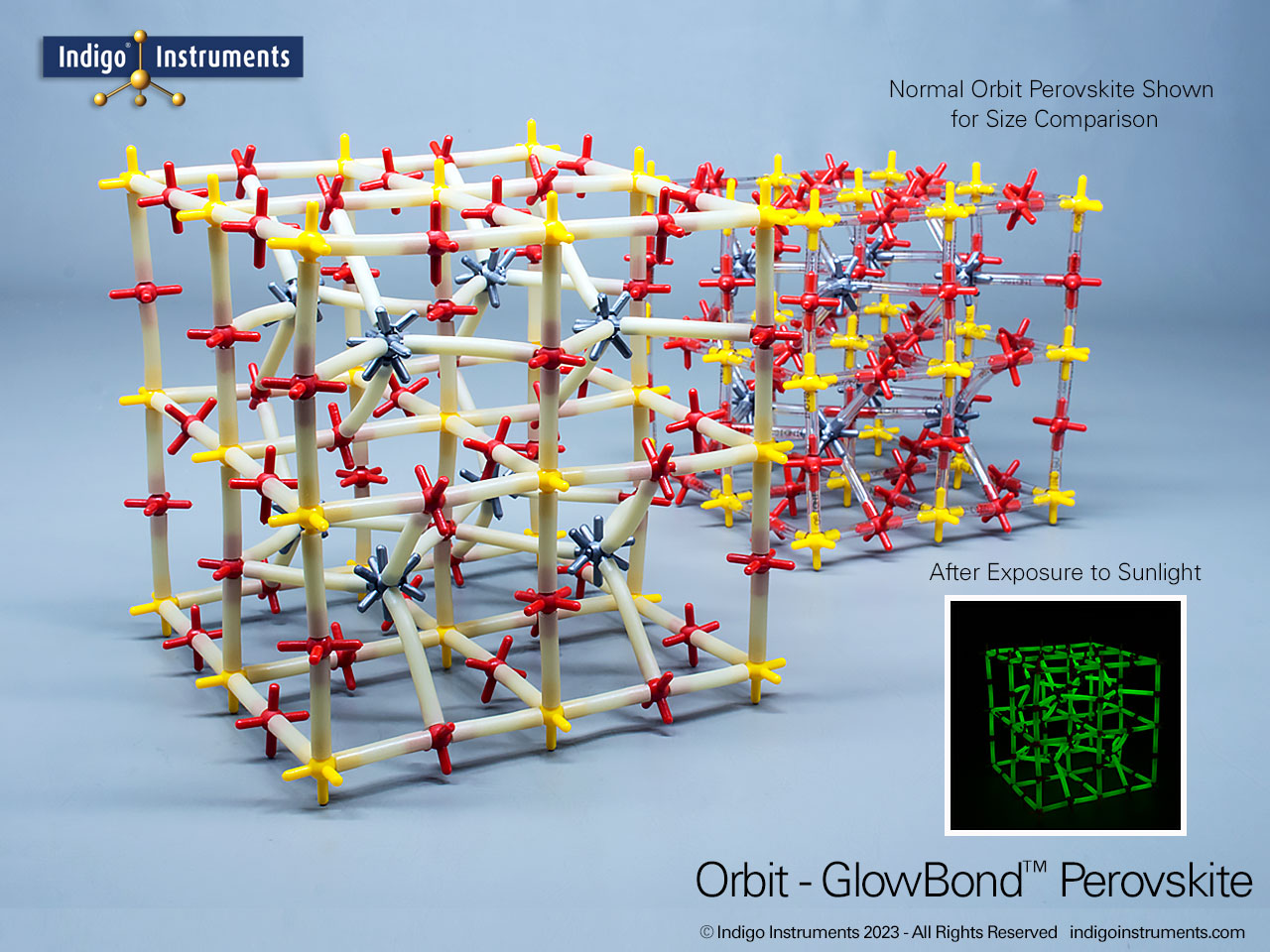
The Indigo® perovskite unit cell molecular model shows Oh point group symmetry, ABX3 cubic crystal structure, and 12-coordinate A-site cation geometry. It's ideal for solid state chemistry, crystallography, materials science, and energy research courses.
The Indigo® perovskite unit cell model reflects the full cubic symmetry of an ideal perovskite. It also helps understand the structure's general formula ABX3, its belonging to the Oh point group and the crystallographic space group Pm3m. In calcium titanate (CaTiO3), the prototype perovskite mineral, the A-site Ca2+ cations occupy the corners of the unit cell in a 12-coordinate cuboctahedral geometry, the B-site Ti4+ cation sits at the body center octahedrally coordinated by six oxygen anions, and the X-site O2- anions occupy the face centers of the cube.
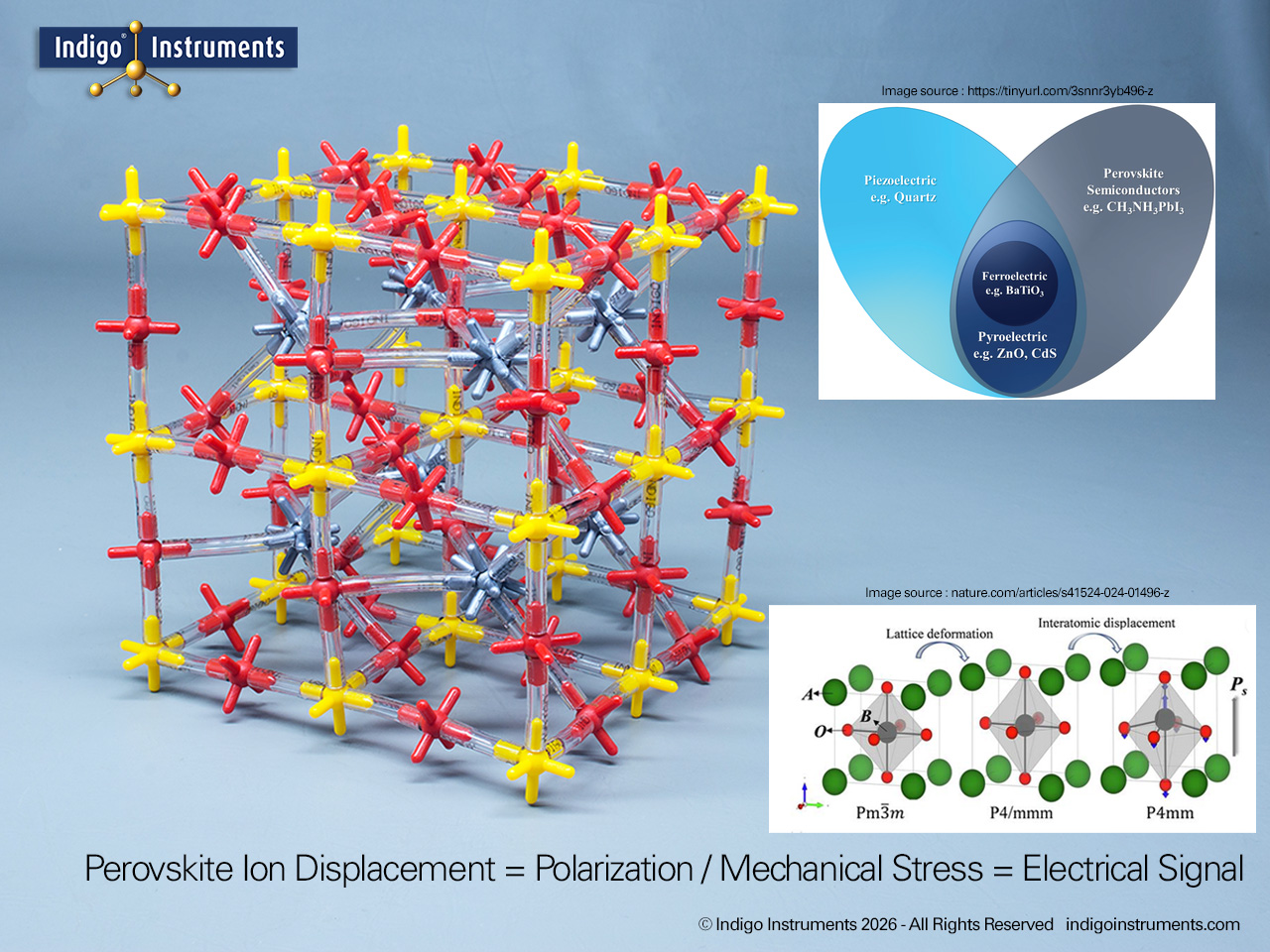
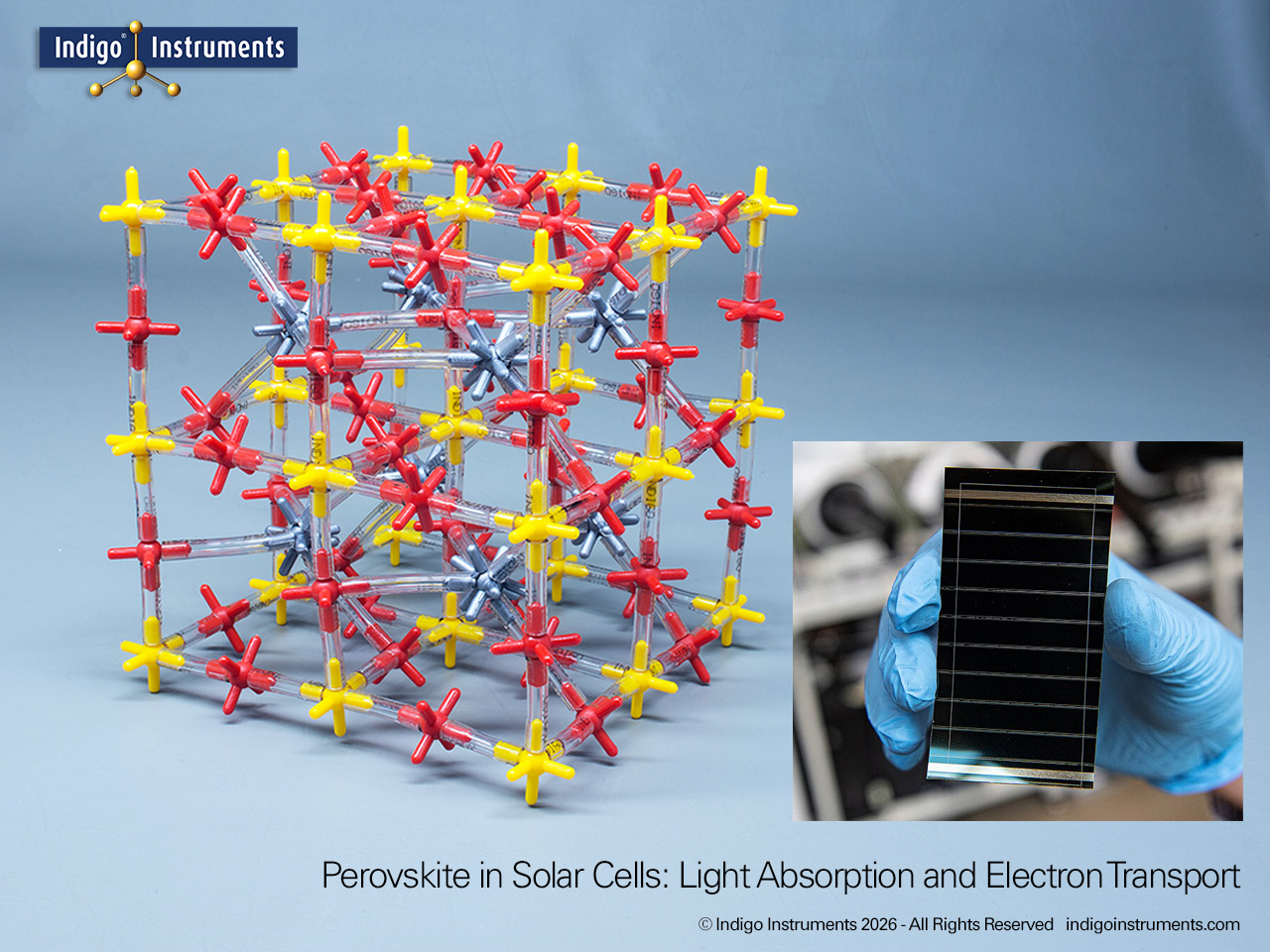
The perovskite structure isa technologically consequential crystal used in a diverse family of materials spanning ferroelectrics, superconductors, solar cells, and catalysts. Barium titanate (BaTiO3) is the archetypal ferroelectric perovskite, whose spontaneous polarization below its Curie temperature arises from a slight distortion of the ideal cubic Oh symmetry that displaces the B-site cation off-center within its oxygen octahedron. Lead zirconate titanate (PZT, Pb(Zr,Ti)O3) is the most widely used piezoelectric material in sensors, actuators, and ultrasound transducers. High-temperature superconductors such as YBa2Cu3O7 adopt layered perovskite-related structures, and hybrid organic-inorganic perovskites such as methylammonium lead iodide (CH3NH3PbI3) have emerged as leading candidates for next-generation photovoltaic solar cells, achieving power conversion efficiencies exceeding 25% in laboratory settings.
In X-ray diffraction, the ideal cubic perovskite belongs to space group Pm3m and produces a characteristic diffraction pattern whose systematic absences and peak positions directly encode the ABX3 structural arrangement. Distortions from ideal cubic symmetry such as octahedral tilting, cation displacement, or Jahn-Teller distortion at the B-site, lower the symmetry to tetragonal, orthorhombic, or rhombohedral space groups. Detecting these distortions by XRD or neutron diffraction is an active area of materials research. For students and instructors building a progressive unit cell model series, the perovskite model pairs naturally with the NaCl rock salt and CaF2 fluorite models to illustrate how the cubic crystal system accommodates fundamentally different coordination geometries and stoichiometries. The 6:6 coordination of rock salt through the 8:4 coordination of fluorite to the complex 12:6:6 coordination of perovskite.
Indigo Instruments has held inventory of genuine Cochranes of Oxford (Orbit) parts for 30+ years (See Skeletal (Orbit/Minit)) that are compatible with every molecular model we have sold since day 1. This level of quality may appear expensive but no parts support from other vendors costs even more.
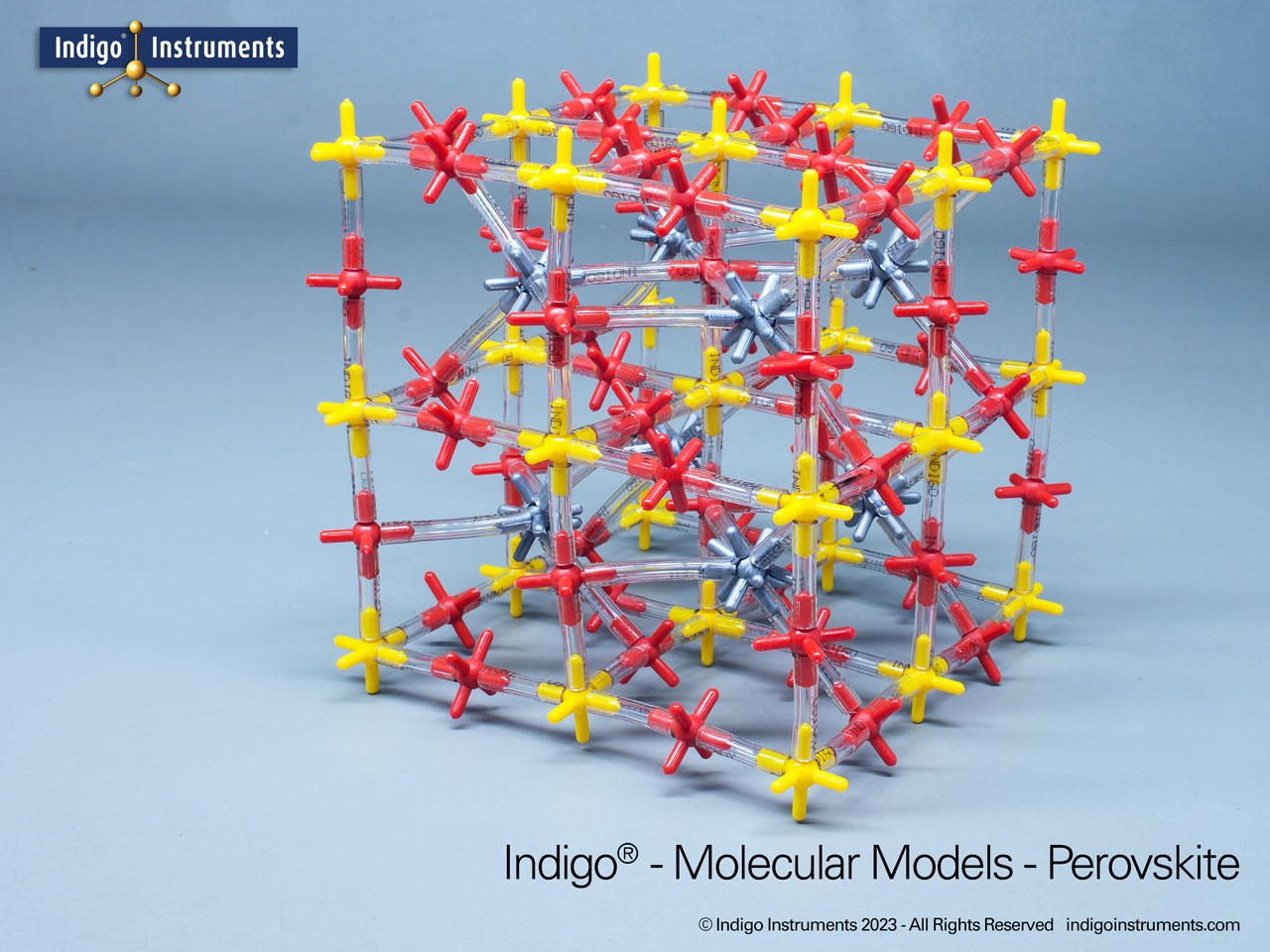
The 12-coordinate A-site atom geometry is unique to the Orbit molecular model system and directly visualizes how large A-site cations sit within the cavities formed by corner-sharing BO6 octahedra. For comparison purposes, the yellow and red atoms in the model can be substituted with blue or green octahedral versions to build different perovskite variants side by side.
| P/N | Description | QTY |
|---|---|---|
| 68186-30 | Wobbly bond, 30mm, each | 108 |
| 68186-50 | Wobbly bond, 50mm, each | 32 |
| 68254C | Atom, Orbit, O "l", octahedral, red | 54 |
| 68255C | Atom, Orbit, S "l", octahedral, yellow | 27 |
| 68265C | Atom, Orbit "q", metal, 12 coordinate, grey | 8 |
There are no printed instructions for assembling either the entire perovskite model or the unit cell. The specifications listed below should be enough to build the unit cell and note that the parts list is for the entire model.
The ideal perovskite structure has the general formula ABX3, consisting of a large A-site cation at the corners of the unit cell in 12-coordinate cuboctahedral geometry, a smaller B-site cation at the body center octahedrally coordinated by six oxygen anions, and X-site oxygen anions at the face centers. The ideal cubic perovskite belongs to the Oh point group and crystallographic space group Pm3m, though real perovskites frequently distort to lower symmetry space groups through octahedral tilting or B-site cation displacement.
The ABX3 framework is remarkably tolerant of chemical substitution; a vast range of combinations of A-site and B-site metal cations can be accommodated as long as the ionic radii and charge balance requirements are satisfied, as expressed by the Goldschmidt tolerance factor. This flexibility allows the perovskite structure to host ferroelectrics, superconductors, magnetic materials, ionic conductors, and photovoltaic absorbers within a single structural framework, making it arguably the most functionally diverse crystal structure type known.
In the ideal cubic Oh perovskite the B-site cation sits at the exact center of its oxygen octahedron, but below a critical temperature many perovskites distort. The B-site cation displaces off-center, octahedra tilt relative to each other, or Jahn-Teller distortion elongates the octahedra asymmetrically. These distortions lower the space group symmetry from cubic Pm3m to tetragonal, orthorhombic, or rhombohedral, and it is precisely these symmetry-breaking distortions that give rise to ferroelectricity in BaTiO3, colossal magnetoresistance in manganite perovskites, and other technologically important properties.
The A-site cation in cubic perovskite occupies a cuboctahedral cavity formed by the corner-sharing network of BO6 octahedra, giving it 12-fold coordination to oxygen. This one of the highest coordination numbers found in common crystal structures. This unusually high coordination number accommodates large cations such as Ca2+, Ba2+, and Pb2+, and the match between A-site cation size and cavity size, quantified by the Goldschmidt tolerance factor, is the primary determinant of whether a given ABX3 compound will adopt the ideal cubic perovskite structure or distort to a lower symmetry form.
Hybrid organic-inorganic perovskites such as methylammonium lead iodide (CH3NH3PbI3) adopt the ABX3 perovskite framework with an organic cation at the A-site and have achieved solar power conversion efficiencies exceeding 25% in laboratory settings, rivaling conventional silicon photovoltaics. Their rapid rise to prominence is directly tied to the structural flexibility of the perovskite framework. The same tolerance for chemical substitution that makes inorganic perovskites useful in ferroelectrics and superconductors allows the bandgap and charge transport properties of perovskite solar absorbers to be tuned systematically by varying the A, B, and X site compositions.