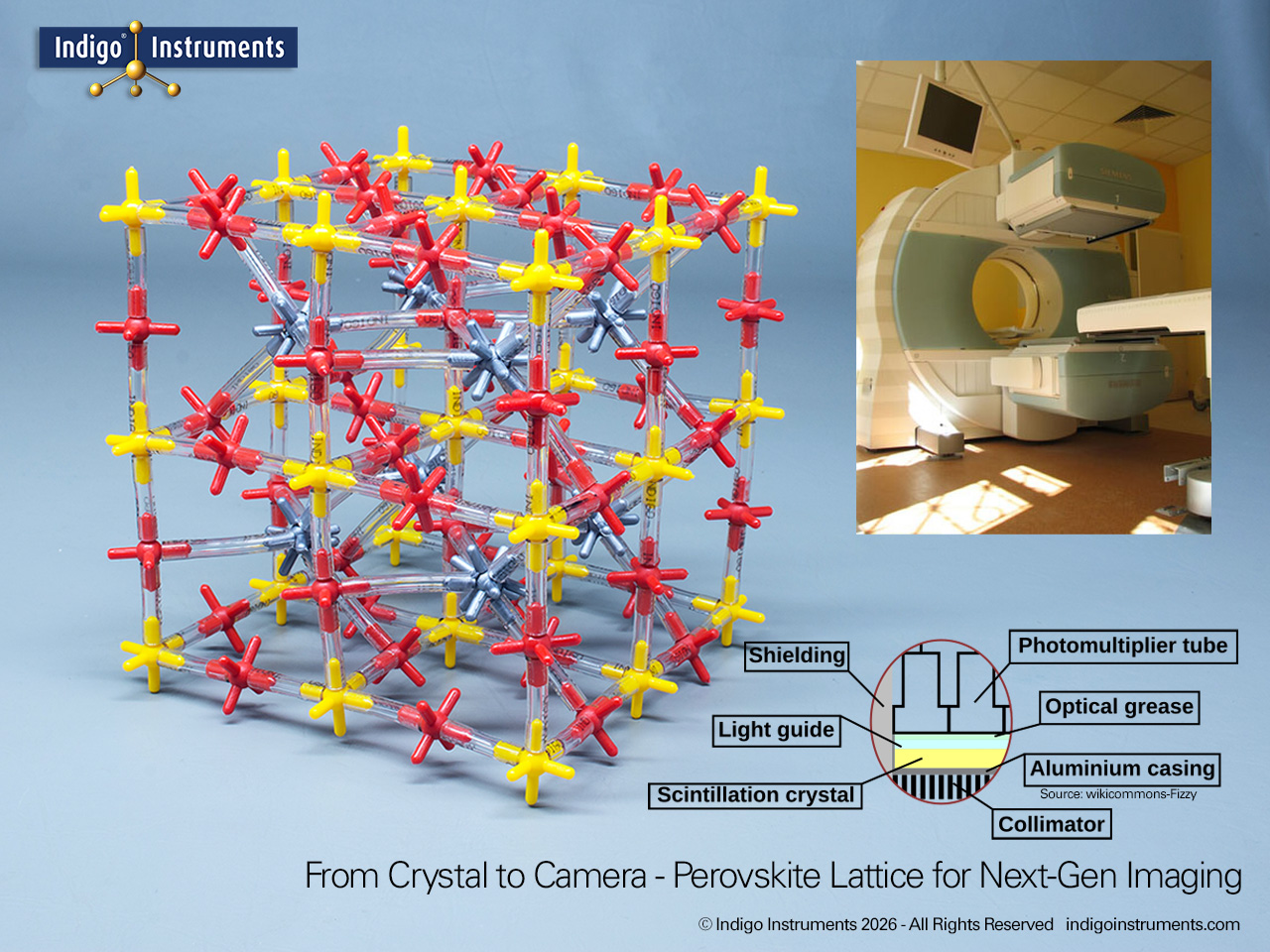
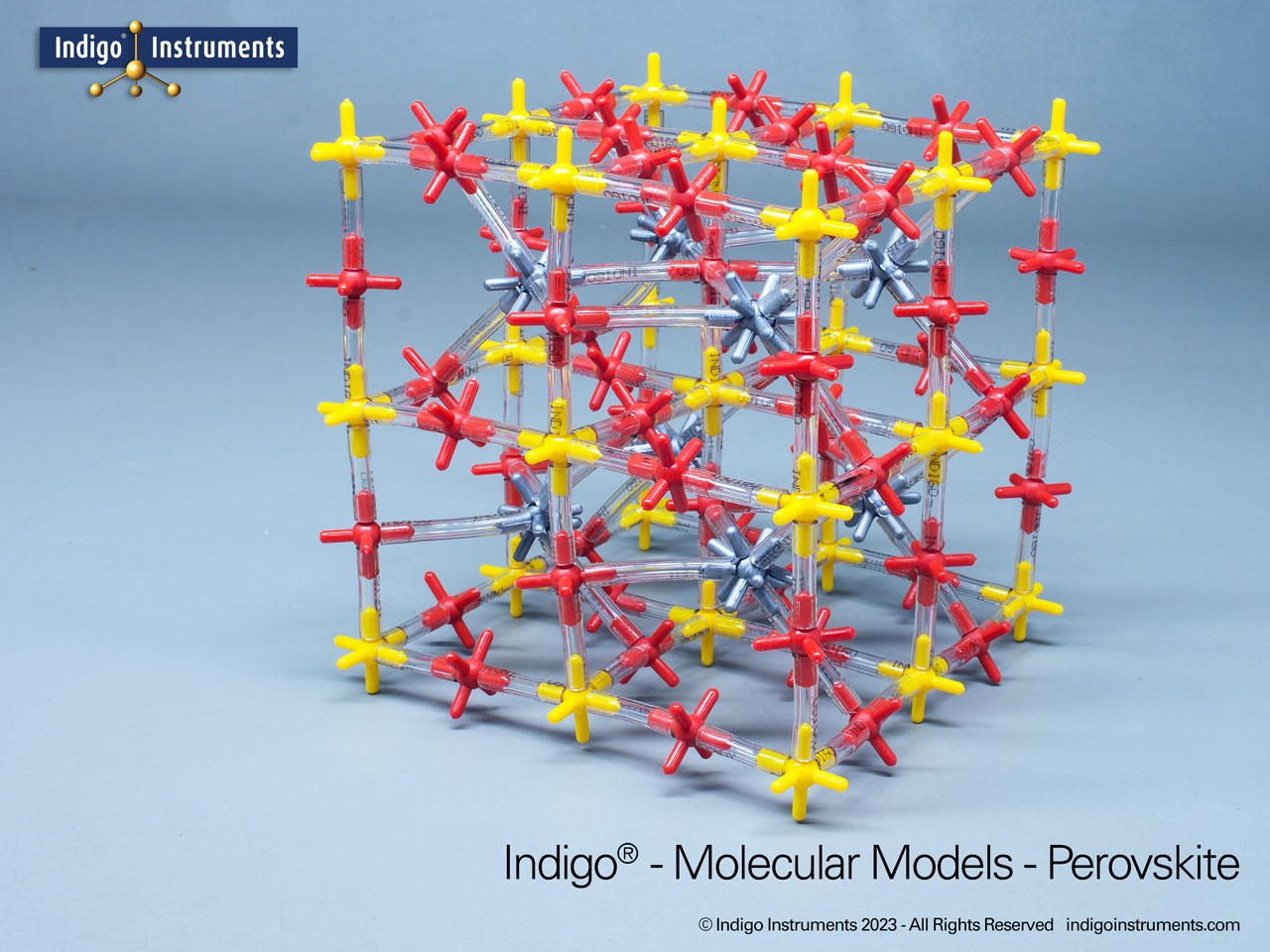
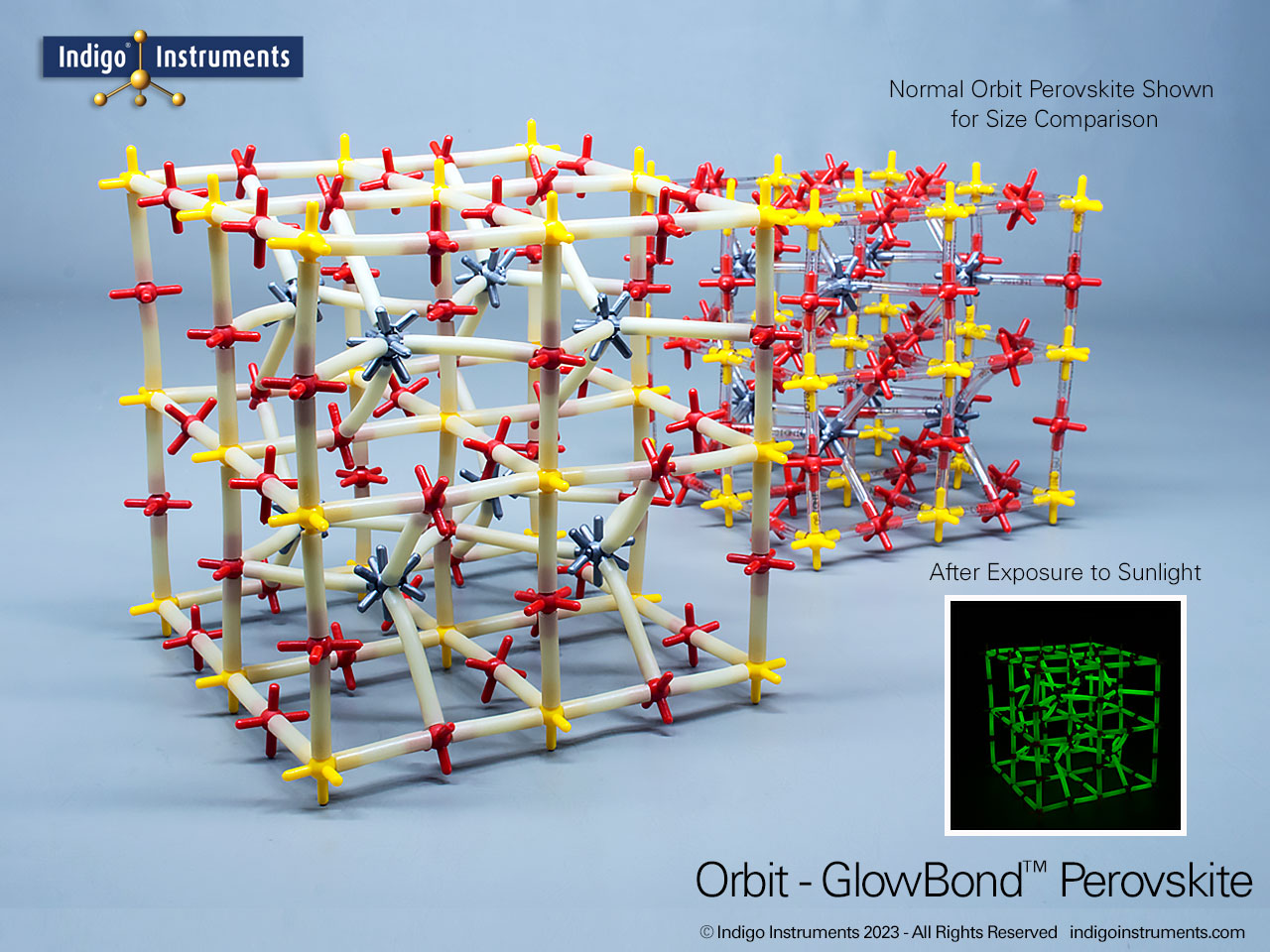
Investigate high-resolution gamma-ray imaging CsPbBr3 crystal based detectors with this Indigo® perovskite crystal lattice model. The potential of low-cost gamma cameras in medical diagnostics is a leap for nuclear medicine.
A breakthrough in medical imaging has emerged through the development of a perovskite-based gamma-ray camera. Using pixelated CsPbBr3 detectors behind a tungsten collimator, researchers have achieved single-photon γ-ray imaging with exceptional energy resolution and spatial detail. This innovation promises to reduce costs, improve image clarity, lower radiation doses, and make advanced nuclear medicine more accessible in clinical settings.
Unlike conventional gamma cameras that rely on expensive scintillators (NaI, CsI) or complex detectors (CZT), perovskite detectors offer a lower-cost, high-performance alternative. This new technology enables single-photon gamma-ray detection, imaging with perovskite semiconductors, and nuclear medicine applications of perovskite detectors. Early experiments show spatial resolution of ~3.2 mm and energy resolution of ~2.5% at 141 keV, rivaling existing commercial systems.
Indigo Instruments has maintained a substantial inventory of genuine Cochranes of Oxford (Orbit) parts for 30+ years (scroll down to see "Skeletal (Orbit/Minit) and are compatible with every molecular model kit we have sold since day 1. This level of quality may appear expensive but no parts support from other vendors costs even more.
| Biomedical / Imaging Focus | Physics & Materials Focus |
|---|---|
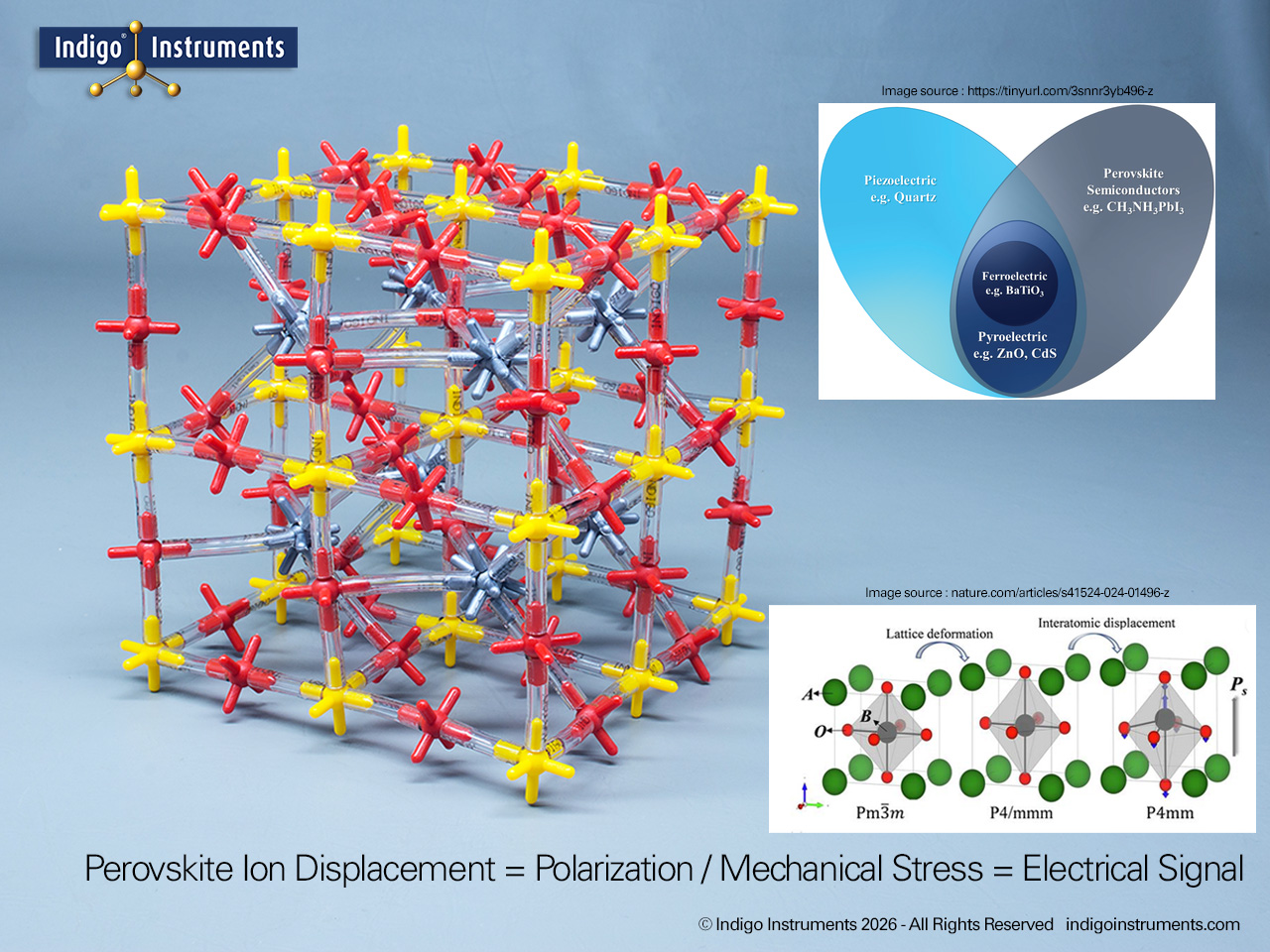
| Understand how perovskite detectors improve nuclear medicine imaging by offering higher sensitivity and resolution compared to conventional NaI(Tl) or CdTe systems. | Visualize the ABX3 perovskite lattice and its role in enabling efficient charge transport and photon detection. |
| Appreciate how lower patient radiation dose and shorter scan times become possible with perovskite-based gamma cameras. | Explore how ionic substitution (e.g., CsPbBr3) alters band gaps, scintillation efficiency, and defect tolerance. |
| Learn why perovskite detectors can expand access to advanced imaging in hospitals & clinics with limited budgets. | Analyze how octahedral tilts, lattice distortion, and structural defects affect detector performance. |
| Gain perspective on the translational pathway from materials science to clinical tools, including regulatory and commercialization considerations. | Compare perovskite detector physics with established gamma-detection crystals, highlighting cost, scalability, and electronic properties. |
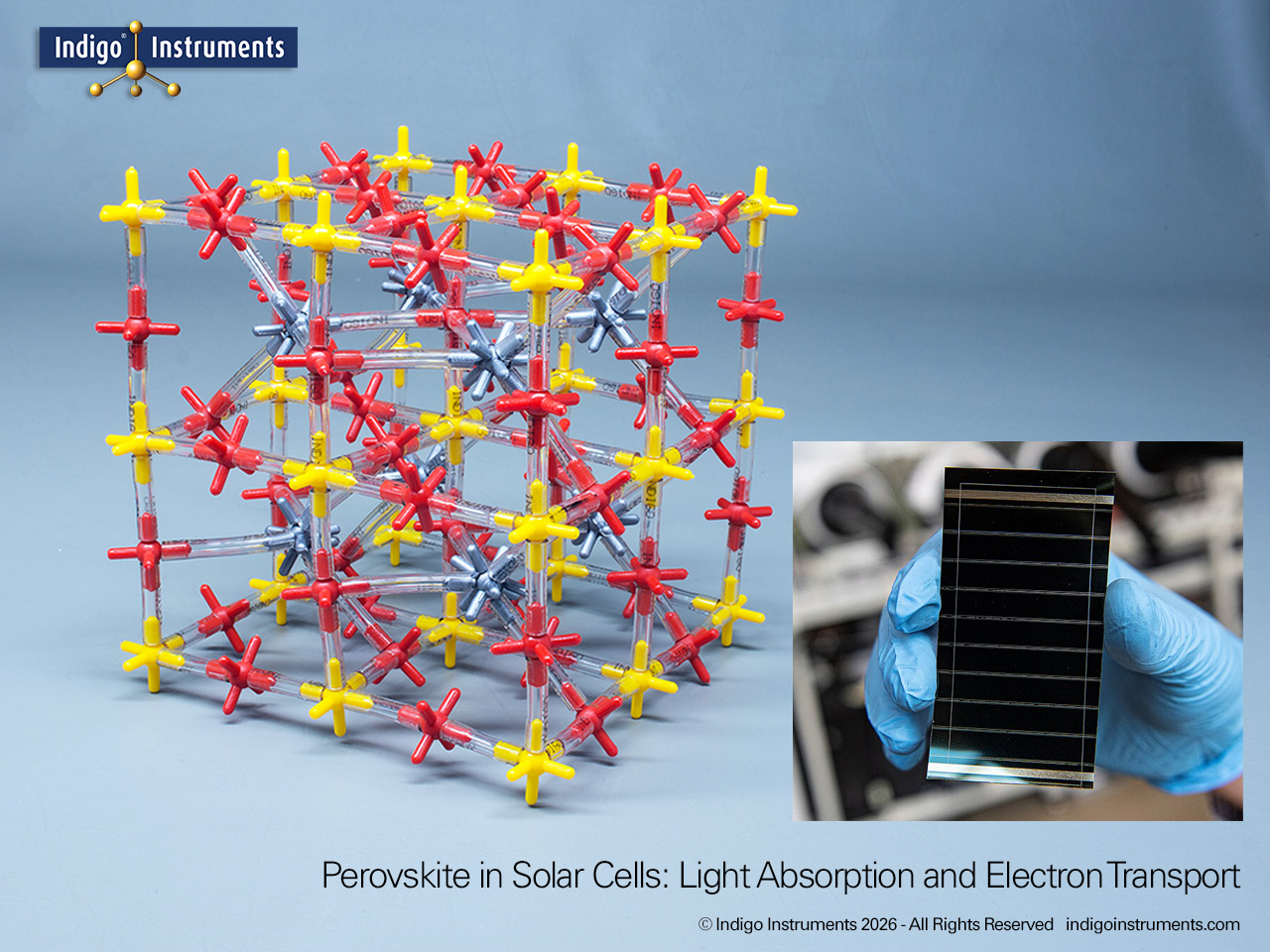
| See how next generation perovskite devices could impact diagnostic fields beyond oncology and cardiology, such as neurology and pediatrics. | Understand how perovskite’s versatility bridges solar cell research with radiation detection applications. |
| P/N | Description | QTY |
|---|---|---|
| 68186-30 | Wobbly bond, 30mm, each | 108 |
| 68186-50 | Wobbly bond, 50mm, each | 32 |
| 68254C | Atom, Orbit, O "l", octahedral, red | 54 |
| 68255C | Atom, Orbit, S "l", octahedral, yellow | 27 |
| 68265C | Atom, Orbit "q", metal, 12 coordinate, grey | 8 |
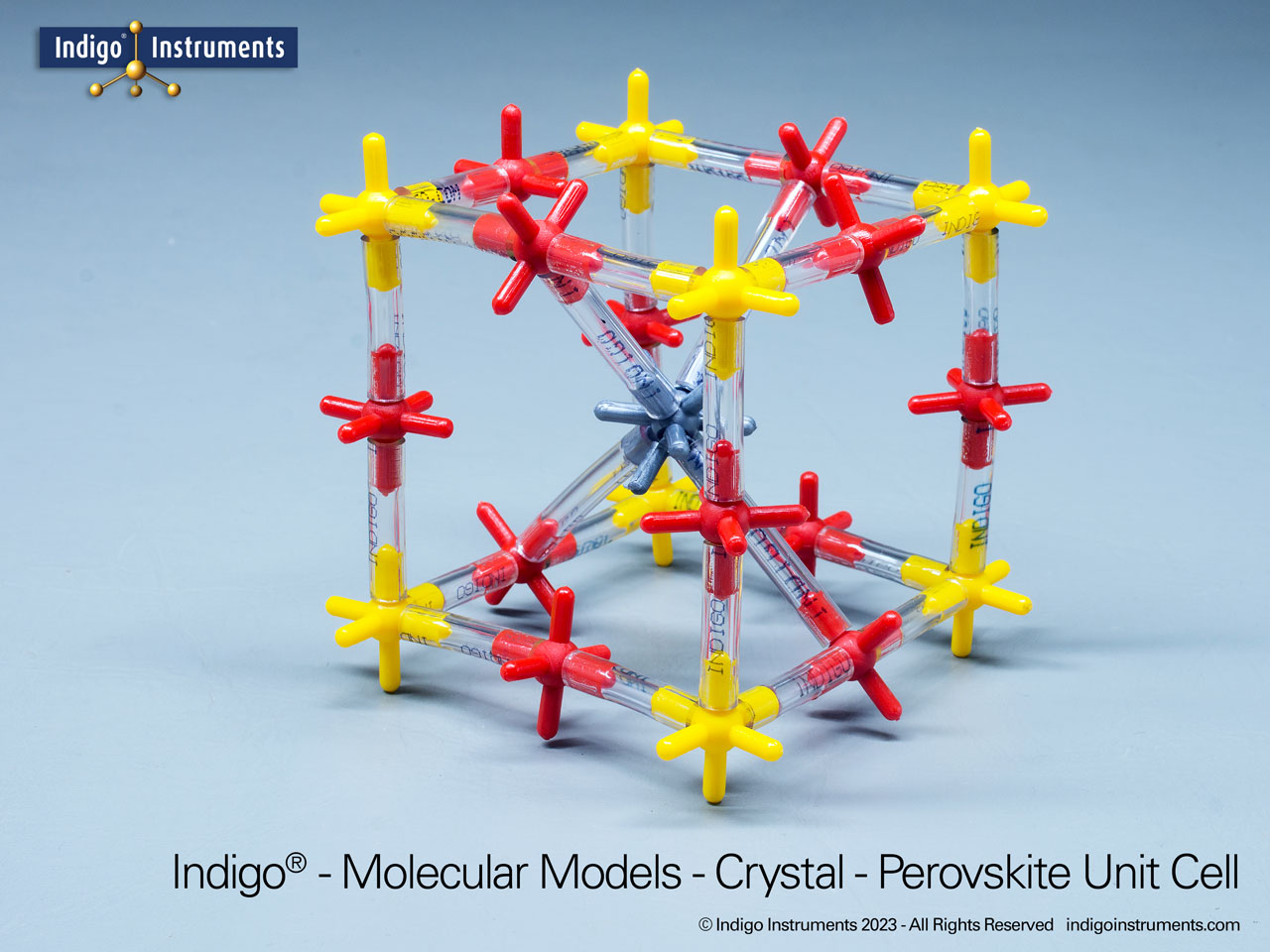
There are no printed instructions for assembling this model. However, these specifications & a close look at the images of the model & unit cell should suffice.