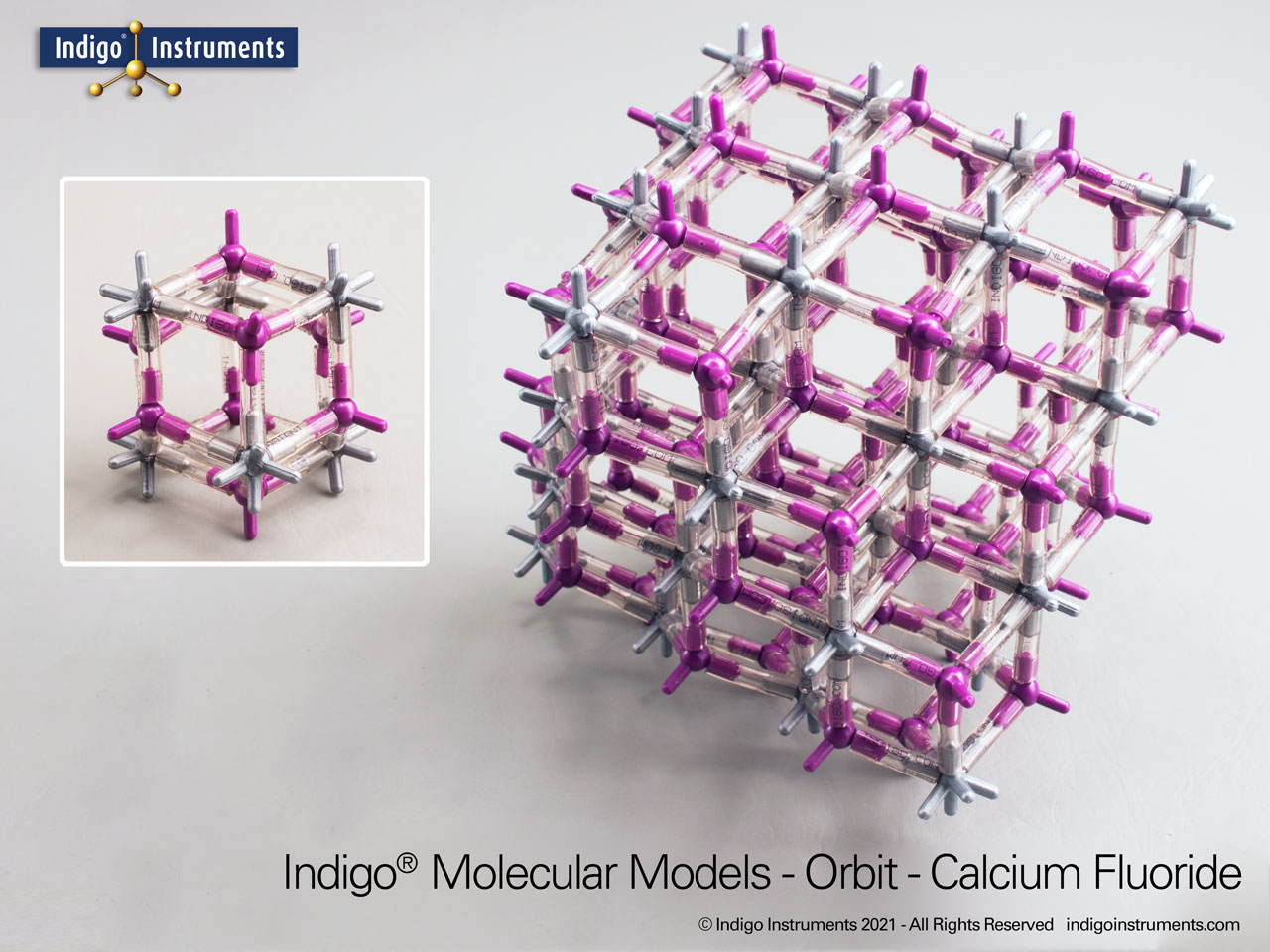
The Indigo® fluorite (CaF2) crystal lattice model comes with 154 atoms that show the 8:4 coordination, cleavage planes, and optical properties & is an ideal teaching tool for materials science & geology learning.
This fluorite crystal structure model kit displays the 8:4 coordination geometry of calcium and fluoride ions, making it a valuable tool for understanding ionic bonding, crystal lattices, and physical properties of solids. With visible cleavage planes and atomic arrangement, the model illustrates how structure influences optical behavior such as low dispersion and UV-IR transparency, as well as mechanical properties. Students, educators, and hobbyists can use it to compare lattice types, explore coordination geometry, and gain tactile insight into concepts that are often shown only in diagrams.
| Feature | Description | Notes / Observations |
|---|---|---|
| Coordination Geometry | Calcium ions: 8 fold; Fluoride ions: 4 fold | Demonstrates the 8:4 ionic lattice typical of fluorite; foundational for understanding crystal packing in solid-state chemistry and materials design. |
| Cleavage Planes | 4 planes along cube faces | Illustrates why fluorite splits cleanly along these directions; relevant to mineralogy, crystallography, and hands-on demonstration of mechanical properties. |
| Optical Properties | Low dispersion, UV/IR transparency | Links crystal structure to optical performance, e.g., in lenses and prisms; useful for physics, materials science, and educational demonstrations of light behavior in solids. |
| Hardness | Mohs 4 | Relatively soft for a mineral; easy to scratch with a knife, but harder than many common solids. Illustrates relative hardness in teaching mineralogy. |
| Fluoride Relevance | Contains F ions | Offers a chance to discuss natural fluorite vs. fluoride in groundwater and dental applications: highlights connections between chemistry, geology, and environmental science. |
| Gemological Distinction | Colorful mineral, can resemble amethyst | Teaching point: fluorite is softer, cleaves differently, and fluoresces under UV light; useful in basic gemology or chemistry demonstrations of light interaction with minerals. |
Indigo Instruments has held inventory of genuine Cochranes of Oxford (Orbit) parts for 30+ years (See Skeletal (Orbit/Minit)) that are compatible with every molecular model we have sold since day 1. This level of quality may appear expensive but no parts support from other vendors costs even more.
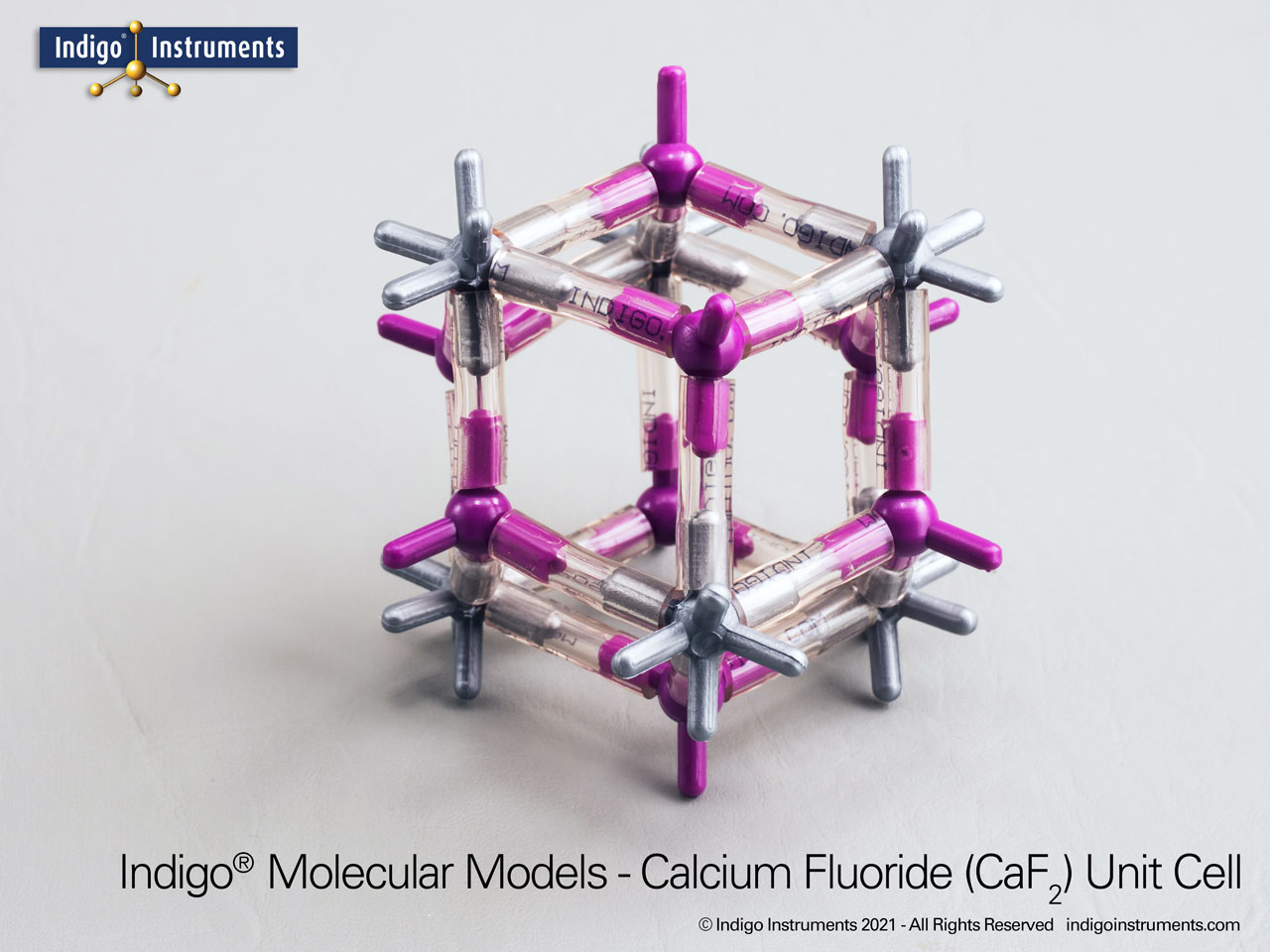
| Concept | Observable / Hands-On Outcome | Applicable Audience |
|---|---|---|
| Coordination geometry (8:4 coordination) | Observe calcium surrounded by 8 fluorides, fluoride surrounded by 4 calcium ions | Chemistry / Materials Science / Geology Students |
| Cleavage planes | Identify 4 directions in which crystal tends to split cleanly | Geology / Mineralogy / Solid State Physics |
| Ionic bonding & lattice stability | Visualize lattice arrangement and predict which ions are stable where | General Chemistry / Solid State Chemistry |
| Optical properties | Connect structure with refractive index, transparency, UV/IR transmission | Physics / Optics / Microscopy Students |
| P/N | Description | QTY |
|---|---|---|
| 68186-25 | Wobbly bond, 25mm, each | 271 |
| 68247C | Atom, Orbit, P "k", tetrahedral, purple | 88 |
| 68264C | Atom, Orbit "p", metal, 8 coordinate, grey | 44 |