ZnO Wurtzite Hexagonal Prism Structure

SKU: 68764W
$55.95USD Each

Qty:

Photocatalytic applications of ZnO nanowires are of increased interest in environmental protection applications.

Zinc oxide nanoparticles have remarkable optical, physical, and antimicrobial properties and therefore have great potential to enhance agriculture.

The powder ZnO is widely used as an additive in numerous materials and products including ceramics, glass, cement, rubber (e.g., car tyres), lubricants, paints, ointments, adhesives, plastics, sealants, pigments, foods (source of Zn nutrient), batteries, ferrites, and fire retardants.

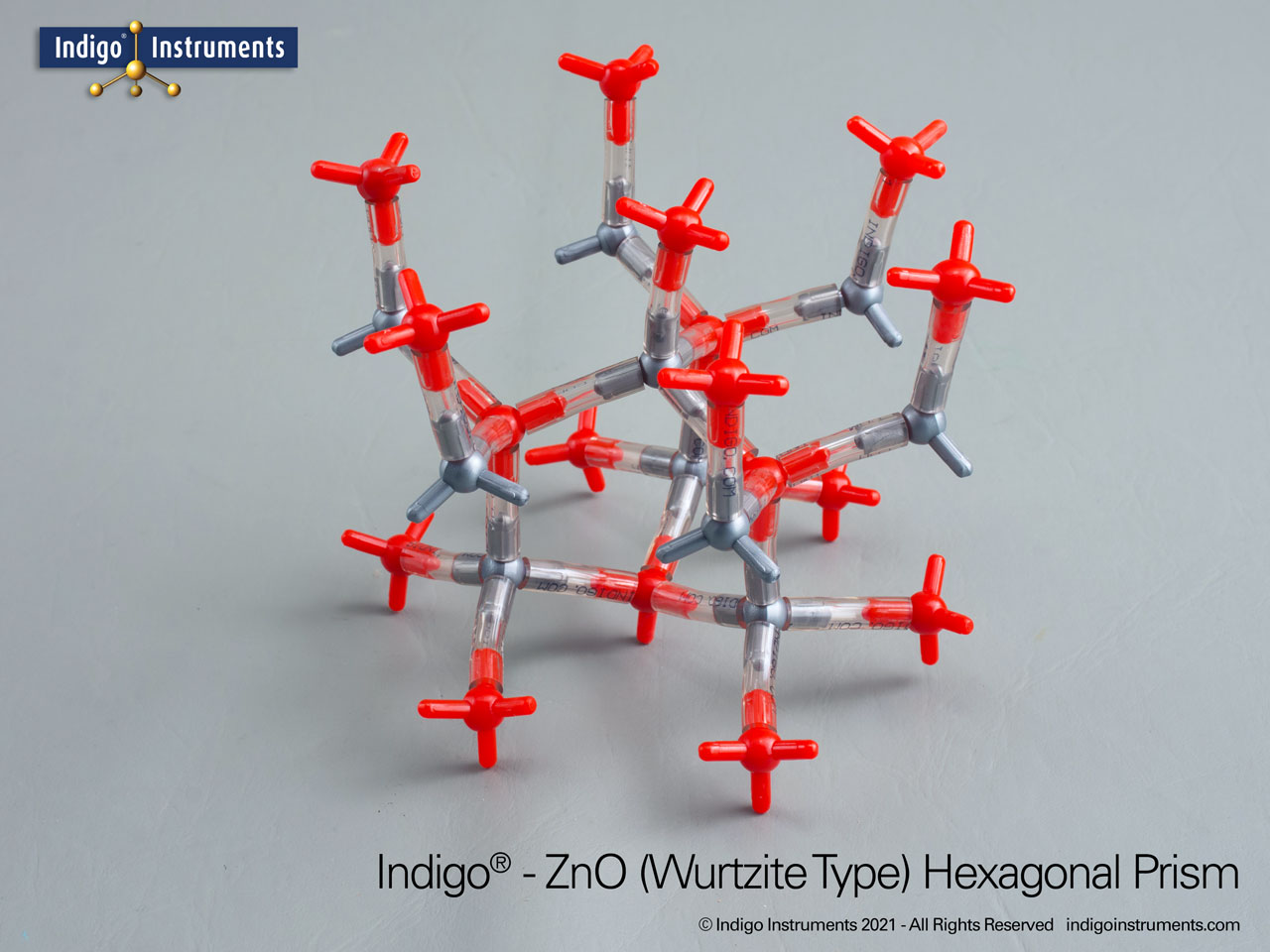
The hexagonal prism shown for ZnO is is comprised of 3 unit cells. The oxygen are red and the Zn is silver in the model using conventional IUPAC notation for its constituent elements.

Key Teaching Values of the Indigo® ZnO Wurtzite Unit Cell Model

A zinc oxide (ZnO) unit cell molecular model is useful for 3D visualization of non-centrosymmetric crystals, polarity, and tetrahedral coordination. The key teaching values are:

Visualization of the Wurtzite Structure

The model shows the hexagonal wurtzite (B4) structure with lattice parameters a and c (a = 3.25 Å, c = 5.20 Å), illustrating how the hexagonal unit cell extends periodically in three dimensions.

Tetrahedral sp3 Coordination

Each Zn atom is surrounded by four oxygen atoms (and vice versa) at the corners of a tetrahedron, directly demonstrating the sp3 covalent bonding character of the Zn–O interaction.

Polarity and Asymmetry

The model highlights the non-centrosymmetric nature of the wurtzite structure and shows how the Zn–O tetrahedral arrangement leads to polar surfaces with Zn-terminated (0001) and O-terminated (0001) faces.

Understanding Stoichiometry

The model aids in visualizing the 1:1 ratio of Zn to O atoms within the unit cell, where zinc atoms occupy half of the tetrahedral holes in a hexagonal close-packed (HCP) array of oxygen atoms.

Piezoelectricity Foundation

The unit cell model helps explain why ZnO is piezoelectric — a property directly linked to the non-centrosymmetric C6v symmetry of the wurtzite unit cell, which prevents cancellation of ionic displacements under mechanical stress.

Defect Modelling

Instructors can use the model to demonstrate structural defects such as the displacement of atoms from their ideal positions, quantified by the atomic displacement parameter u, which describes how far the Zn or O atom deviates from its ideal tetrahedral site along the c-axis.

Indigo Instruments has held inventory of genuine Cochranes of Oxford (Orbit) parts for 30+ years (See Skeletal (Orbit/Minit)) that are compatible with every molecular model we have sold since day 1. This level of quality may appear expensive but no parts support from other vendors costs even more.


Details
Related information or images
Parts
Reviews ()
Review This Product Now!


Frequently Asked Questions

FAQ for ZnO Wurtzite Hexagonal Prism Structure

The ZnO wurtzite model directly visualizes the hexagonal C6v point group and space group P63mc in three dimensions. The lattice parameters a = 3.25 Å and c = 5.20 Å are clearly reflected in the hexagonal prism geometry. This makes abstract crystallographic concepts such as non-centrosymmetric symmetry, polar axes, and hexagonal close-packing immediately tangible in a way that two-dimensional diagrams cannot replicate.

The model shows each Zn2+ ion surrounded by four O2- ions at the corners of a tetrahedron and vice versa, directly illustrating the sp3 bonding character of the Zn–O interaction. This 4:4 tetrahedral coordination is identical in geometry to that seen in diamond and methane (Td), but the polar wurtzite stacking sequence breaks the inversion symmetry that those structures possess, producing fundamentally different physical properties.

The hexagonal prism model shows the asymmetry between the Zn-terminated (0001) and O-terminated (0001) faces at opposite ends of the c-axis. These arise directly from the non-centrosymmetric C6v symmetry of the wurtzite structure. These two chemically distinct polar surfaces have different reactivities, surface energies, and growth rates, properties that are central to understanding ZnO nanowire growth, thin film deposition, and photocatalytic behavior.

The 1:1 ratio of Zn to O atoms in the unit cell is directly visible in the model. Zinc atoms occupy exactly half of the available tetrahedral holes in the hexagonal close-packed oxygen sublattice, leaving the other half empty. This half-filling of tetrahedral sites produces the 1:1 stoichiometry of ZnO that distinguishes the wurtzite structure from the antifluorite structure where all tetrahedral sites are occupied.

Piezoelectricity in ZnO arises directly from its non-centrosymmetric C6v crystal symmetry. When mechanical stress is applied along the c-axis, the Zn2+ and O2- sublattices displace asymmetrically, generating a net electric polarization. The unit cell model shows how the tetrahedral coordination geometry and polar stacking sequence prevent the cancellation of ionic displacements that would occur in a centrosymmetric structure. This provides a concrete structural foundation for understanding piezoelectric behavior in ZnO nanogenerators and sensors.

Instructors can use the model to illustrate how atoms can be displaced from their ideal tetrahedral positions along the c-axis, quantified crystallographically by the atomic displacement parameter u. In ideal wurtzite ZnO, u = 0.375. Any deviation from this value indicates distortion of the tetrahedral coordination geometry and directly affect ZnO's piezoelectric coefficient, bandgap, and surface reactivity. This make defect modelling a bridge between crystal structure and functional material properties.