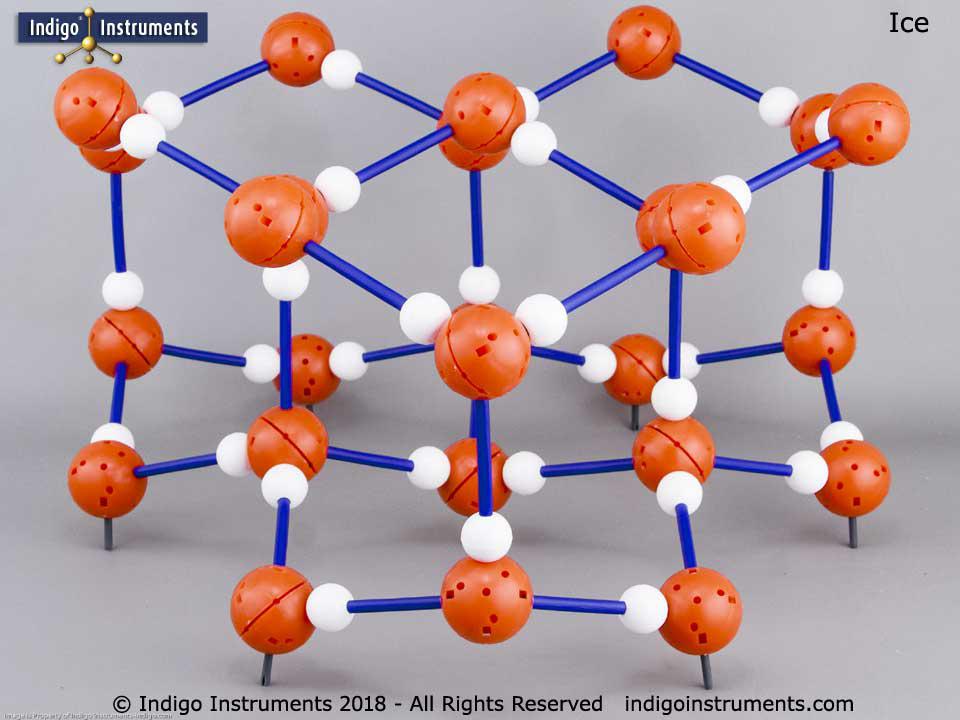
Crystalline Ice Phases
Crystal system, space group, and point group for all 22 experimentally established phases (Ice Ih through Ice XXI)
| # |
Common name |
Crystal system |
Space group |
Point group |
Notes |
| 1 |
Ice Ih |
Hexagonal |
P6?/mmc |
6/mmm (D6h) |
Ordinary ice/snow; hydrogen-disordered |
| 2 |
Ice Ic |
Cubic |
Fd3?m |
m3?m (Oh) |
Diamond-like oxygen framework; hydrogen-disordered |
| 3 |
Ice II |
Trigonal (rhombohedral) |
R3? |
3? (S6) |
Fully hydrogen-ordered |
| 4 |
Ice III |
Tetragonal |
P4?2?2 |
422 (D4) |
Chiral; hydrogen-disordered; pairs with IX |
| 5 |
Ice IV |
Trigonal (rhombohedral) |
R3?c |
3?m (D3d) |
Metastable; hydrogen-disordered |
| 6 |
Ice V |
Monoclinic |
A2/a (C2/c) |
2/m (C2h) |
Most topologically complex network; disordered; pairs with XIII |
| 7 |
Ice VI |
Tetragonal |
P4?/nmc |
4/mmm (D4h) |
Two interpenetrating networks; disordered; pairs with XV & XIX |
| 8 |
Ice VII |
Cubic |
Pn3?m |
m3?m (Oh) |
Two interpenetrating diamond networks; disordered |
| 9 |
Ice VIII |
Tetragonal |
I4?/amd |
4/mmm (D4h) |
Hydrogen-ordered low-temperature form of VII |
| 10 |
Ice IX |
Tetragonal |
P4?2?2 |
422 (D4) |
Ordered form of III; chiral |
| 11 |
Ice X |
Cubic |
Pn3?m |
m3?m (Oh) |
Symmetric hydrogens at O-O midpoints; bcc oxygen substructure |
| 12 |
Ice XI |
Orthorhombic |
Cmc2? |
mm2 (C2v) |
Hydrogen-ordered form of Ice Ih |
| 13 |
Ice XII |
Tetragonal |
I4?2d |
4?2m (D2d) |
Metastable; disordered; pairs with XIV |
| 14 |
Ice XIII |
Monoclinic |
P2?/a |
2/m (C2h) |
Ordered form of V |
| 15 |
Ice XIV |
Orthorhombic |
P2?2?2? |
222 (D2) |
Ordered form of XII |
| 16 |
Ice XV |
Triclinic (pseudo-orthorhombic) |
P1? |
1? (Ci) |
Antiferroelectric ordered sibling of VI, alongside XIX |
| 17 |
Ice XVI |
Cubic |
Fd3?m |
m3?m (Oh) |
Empty structure-II clathrate framework; least dense ice known |
| 18 |
Ice XVII |
Hexagonal |
P6?22 |
622 (D6) |
Chiral spiral channels; empty filled-ice framework |
| 19 |
Ice XVIII |
Cubic (fcc) |
Fm3?m* |
m3?m (Oh)* |
Superionic; oxygen fcc lattice, hydrogens diffusive/liquid-like |
| 20 |
Ice XIX |
Tetragonal |
P4? |
4? (S4) |
Second hydrogen-ordered sibling of VI, alongside XV |
| 21 |
Ice XX |
Cubic (bcc) |
Im3?m* |
m3?m (Oh)* |
Superionic; oxygen bcc lattice, hydrogens diffusive/liquid-like |
| 22 |
Ice XXI |
Tetragonal (body-centred) |
I4?2d |
4?2m (D2d) |
Newest (2025); unusually large and complex unit cell |
*Superionic-phase space groups describe the oxygen sublattice only. At these pressures and temperatures the hydrogens are mobile and diffuse through the lattice rather than occupying fixed crystallographic sites, so no conventional full-structure space group applies.
Ice Ih and Ice Ic are both forms of "Ice I" and are not always assigned separate Roman numerals in every counting convention, which is why total phase counts can vary by one between sources.
Ice XII and Ice XXI happen to share the same space-group symbol (I4bar2d) despite being structurally unrelated networks of very different size and origin.